Last reviewed on May 01, 2023
Pediatric Nuclear Medicine
Children's (pediatric) nuclear medicine imaging uses small amounts of radioactive materials called radiotracers, a special camera and a computer to help diagnose childhood disorders that are present at birth or that develop during childhood. It provides unique information that often cannot be obtained using other imaging procedures.
Tell your doctor about your child's recent illnesses, medical conditions, treatments, medications and allergies. Depending on the type of exam, your doctor will instruct you on what your child may eat or drink beforehand, especially if sedation or general anesthesia is to be used. Most nuclear medicine exams will involve an injection in a vein in your child's arm or hand. Your child should wear loose, comfortable clothing and may be asked to wear a gown.
- What is Pediatric Nuclear Medicine?
- What are some common uses of the procedure?
- How does the nuclear medicine procedure work?
- What does the equipment look like?
- How is the procedure performed?
- What will my child experience during and after the procedure?
- How should I prepare my child for the procedure?
- Who interprets the results and how do we get them?
- What are the benefits vs. risks?
- What are the limitations of Pediatric Nuclear Medicine?
What is Pediatric Nuclear Medicine?
Nuclear medicine uses small amounts of radioactive material called radiotracers. Doctors use nuclear medicine to diagnose, evaluate, and treat various diseases. These include cancer, heart disease, gastrointestinal, endocrine, or neurological disorders, and other conditions. Nuclear medicine exams pinpoint molecular activity. This gives them the potential to find disease in its earliest stages. They can also show whether you are responding to treatment.
Children's (pediatric) nuclear medicine refers to imaging examinations done in babies, young children and teenagers.
Nuclear medicine is noninvasive. Except for intravenous injections, it is usually painless. These tests use radioactive materials called radiopharmaceuticals or radiotracers to help diagnose and assess medical conditions.
Radiotracers are molecules linked to, or "labeled" with, a small amount of radioactive material. They accumulate in tumors or regions of inflammation. They can also bind to specific proteins in the body. The most common radiotracer is F-18 fluorodeoxyglucose (FDG), a molecule similar to glucose. Cancer cells are more metabolically active and may absorb glucose at a higher rate. This higher rate can be seen on PET scans. This allows your doctor to detect disease before it may be seen on other imaging tests. FDG is just one of many radiotracers in use or in development.
You will usually receive the radiotracer in an injection. Or you may swallow it or inhale it as a gas, depending on the exam. It accumulates in the area under examination. A special camera detects gamma ray emissions from the radiotracer. The camera and a computer produce pictures and supply molecular information.
Many imaging centers combine nuclear medicine images with computed tomography (CT) or magnetic resonance imaging (MRI) to produce special views. Doctors call this image fusion or co-registration. Image fusion allows the doctor to connect and interpret information from two different exams on one image. This leads to more precise information and a more exact diagnosis. Single photon emission CT/CT (SPECT/CT) and positron emission tomography/CT (PET/CT) units can perform both exams at the same time. PET/MRI is an emerging imaging technology. It is not currently available everywhere.
What are some common uses of the procedure?
Children's (pediatric) nuclear medicine imaging is performed to help diagnose childhood disorders that are congenital (present at birth) or that develop during childhood.
Physicians use nuclear medicine imaging to evaluate organ systems, including the:
- kidneys and bladder.
- bones.
- liver and gallbladder.
- gastrointestinal tract.
- heart.
- lungs.
- brain.
- thyroid.
Nuclear medicine scans are typically used to help diagnose and evaluate:
- urinary blockage in the kidney.
- backflow of urine from the bladder into the kidney (reflux).
- bone cancer, infections and trauma.
- gastrointestinal bleeding and motility.
- tumors and the spread of cancerous cells in the body.
- jaundice in newborns and older children.
- lung perfusion.
- epilepsy.
- location, anatomy and function of the thyroid gland.
How does the nuclear medicine procedure work?
Ordinary x-ray exams pass x-rays through the body to create an image. Nuclear medicine uses radioactive materials called radiopharmaceuticals or radiotracers. Your doctor typically injects this material into your bloodstream. Or you may swallow it or inhale it as a gas. The material accumulates in the area under examination, where it gives off gamma rays. Special cameras detect this energy and, with the help of a computer, create pictures that detail how your organs and tissues look and function.
Hybrid imaging techniques (PET/CT, SPECT/CT and PET/MR) acquire two types of scans at the same time and are most often used in children with cancer, epilepsy and back pain.
What does the equipment look like?
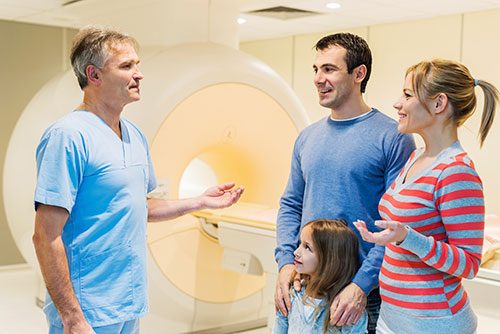
A PET scanner is a large machine with a round, donut-shaped hole in the middle. It looks like a CT or MRI unit. Multiple rings of detectors inside the machine record the energy emissions from the radiotracer in your body.
Nuclear medicine uses a special gamma camera and single-photon emission-computed tomography (SPECT) imaging techniques.
The gamma camera records the energy emissions from the radiotracer in your body and converts it into an image. The gamma camera itself does not emit any radiation. It has radiation detectors called gamma camera heads. These are encased in metal and plastic, often shaped like a box, and attached to a round, donut-shaped gantry. The patient lies on an exam table that slides in between two parallel gamma camera heads, above and beneath the patient. Sometimes, the doctor will orient the gamma camera heads at a 90-degree angle over the patient's body.
In SPECT, the gamma camera heads rotate around the patient's body to produce detailed, three-dimensional images.
A computer creates the images using the data from the gamma camera.
A probe is a small hand-held device resembling a microphone that can detect and measure the amount of the radiotracer in a small area of your child's body.
How is the procedure performed?
Doctors perform nuclear medicine exams on outpatients and hospitalized patients.
The type of nuclear medicine examination will determine how the radiotracer is introduced into your child's body. For example:
- Intravenous - a small needle is used to inject the radiotracer. The needle is removed immediately after injection. Sometimes, an intravenous catheter must stay in place for the duration of the exam.
- Oral - the radiotracer is taken by mouth, such as for a gastric emptying test.
- Inhaled - the radiotracer will be inhaled as a gas via a mask, such as with a lung scan.
- Bladder – a catheter is inserted into the bladder, such as with a vesicoureteral reflux study.
It can take several seconds to a few days for radiotracers to travel through your child's body and accumulate in the organ or area being studied. As a result, imaging may be done immediately, a few hours later, or even a few days after your child receives the radioactive material.
When it is time for the imaging to begin, your child will lie down on an examination table. The gamma camera or scanner will then take a series of images. The camera may rotate around your child, or the camera will stay in one position and your child will be asked to change positions in between images, or the table will move your child through the scanner. While the camera is taking pictures, your child will need to remain still for brief periods of time. Actual scanning time varies from 20 minutes to several hours. Examinations that require longer imaging times may require sedation or general anesthesia for your child, in which case you will receive preparation instructions prior to the exam.
During this procedure, parents are usually allowed and often encouraged to stay in the room. The exception to this is if the child's mother is pregnant.
When the examination is completed, your child will be asked to wait until the nuclear physician checks the images in case additional images are needed.
What will my child experience during and after the procedure?
Except for intravenous injections, most nuclear medicine procedures are painless. Reports of significant discomfort or side effects are rare.
If the radiotracer is given intravenously, your child will feel a pin prick, much like a shot, when the needle is inserted into the vein. When the radioactive material is injected into the arm, your child will generally not experience any discomfort. When swallowed, the radiotracer has little or no taste. If inhaled, your child should feel no differently than when breathing room air or holding their breath.
With some exams, a catheter may be placed into the bladder, which may cause temporary discomfort.
It is important that your child remains very still while the images are being recorded. Though nuclear imaging itself causes no pain, children may experience some discomfort from having to remain still during imaging. Parents are encouraged to stay with their children to help them remain calm and still during imaging. Comfort items such as pacifiers, blankets, books and songs are also very helpful. Often, a monitor with children's programming and/or children's DVDs are available in the scanning room. You may also play your child's preferred videos on your personal mobile device or tablet.
Unless your physician tells you otherwise, your child may resume normal activities after the nuclear medicine scan. If your child has been sedated or received general anesthesia, you will receive specific instructions to be followed after leaving the nuclear medicine facility.
Through the natural process of radioactive decay, the small amount of radiotracer in your child's body will lose its radioactivity over time. In many cases, the radioactivity will dissipate over the first 24 hours following the test and pass out of your child's body through urine or stool. Your child should also drink plenty of water to help flush the radioactive material from their body.
How should I prepare my child for the procedure?
You may reassure your child that you will be able to stay in the room during the procedure. If your child is old enough, you may choose to explain the procedure yourself. Most pediatric nuclear medicine exams will involve an injection into a vein in your child's arm or hand.
Children should wear comfortable, loose-fitting clothing to the exam, but they may be given a gown to wear during the procedure.
Leave jewelry and accessories at home or remove them prior to the exam. These objects may interfere with the procedure.
You should inform your physician of any medications your child is taking, including vitamins and herbal supplements, in addition to any allergies. Also inform your doctor of any recent illnesses or other medical conditions.
Depending on the type of nuclear scan being performed, you will receive specific preparation instructions for what your child may eat and drink before the exam, especially if your physician plans to use sedation or general anesthesia for the procedure.
For information on how to prepare for a PET exam, visit Positron Emission Tomography - Computed Tomography (PET/CT).
Who interprets the results and how do we get them?
A radiologist or other doctor specially trained in nuclear medicine will interpret the images and send a report to your referring physician.
What are the benefits vs. risks?
Benefits
- The information provided by nuclear medicine examinations is unique and often unattainable using other imaging procedures.
- For many diseases, nuclear medicine scans yield the most useful information needed to make a diagnosis or to determine appropriate treatment, if any.
Risks
- Because the doses of radiotracer administered are small, diagnostic nuclear medicine procedures result in low radiation exposure, acceptable for diagnostic exams. Thus, the radiation risk is very low compared with the potential benefits.
- Nuclear medicine diagnostic procedures have been used for more than five decades, and there are no known long-term adverse effects from such low-dose exposure. For more information about safety in pediatric nuclear medicine procedures, visit the Image Gently website.
- Allergic reactions to radiotracers may occur but are extremely rare and are usually mild. Nevertheless, you should inform the nuclear medicine staff of any allergies your child may have or other problems that may have occurred during a previous nuclear medicine exam.
What are the limitations of Pediatric Nuclear Medicine?
Nuclear medicine procedures can be time consuming. It can take several hours to days for the radiotracer to accumulate in the area of interest. Plus, imaging may take up to several hours to perform. In some cases, newer equipment can substantially shorten the procedure time.
The image resolution of nuclear medicine images may not be as high as that of CT or MRI. However, nuclear medicine scans are more sensitive for a variety of indications. The functional information they yield is often unobtainable using other imaging techniques.
Additional Information and Resources
The Image Gently Alliance: imagegently.org