Pediatric CT
Pediatric computed tomography (CT) is a fast, painless exam that uses special x-ray equipment to create detailed images of your child's internal organs, bones, soft tissues and blood vessels. It may be used to help diagnose abdominal pain or evaluate for injury after trauma.
Tell your doctor about your child's medications and allergies. Inform your doctor and the technologist prior to the exam if your child has a known allergy to contrast material. Your child should wear loose, comfortable clothing and may be asked to wear a gown. You may be instructed to withhold food or drink beforehand, especially if sedation or anesthesia is to be used. In general, children who have recently been ill will not be sedated or anesthetized.
- What is Pediatric CT?
- What are some common uses of the procedure?
- How should we prepare for the CT scan?
- What does the CT equipment look like?
- How does the procedure work?
- How is the procedure performed?
- What will my child experience during and after the procedure?
- Who interprets the results and how do we get them?
- What are the benefits vs. risks?
- What are the limitations of Pediatric CT?
What is Pediatric CT?
Computed tomography, more commonly known as a CT or CAT scan, is a diagnostic medical imaging test. Like traditional x-rays, it produces multiple images or pictures of the inside of the body.
A CT scan generates images that can be reformatted in multiple planes. It can even generate three-dimensional images. Your doctor can review these images on a computer monitor, print them on film or via a 3D printer, or transfer them to a CD or DVD.
CT images of internal organs, bones, soft tissue, and blood vessels provide greater detail than traditional x-rays. This is especially true for soft tissues and blood vessels.
CT scans may be performed on newborns, infants and older children.
What are some common uses of the procedure?
CT is used to help diagnose a wide range of conditions due to injury or illness.
In children, CT is typically used to diagnose causes of abdominal pain, evaluate for injury after trauma, diagnose and stage cancer, monitor response to treatment for cancer, and diagnose and monitor infectious or inflammatory disorders.
CT may also be performed to evaluate blood vessels throughout the body. With CT, it is possible to obtain very detailed pictures of the heart and blood vessels in children, even newborn infants.
Except for the chest x-ray, CT is the most commonly used imaging procedure for evaluating the chest. CT of the chest is used to evaluate:
- complications from infections such as pneumonia
- a tumor that arises in the lung or has spread there from a distant site
- airway disease such as inflammation of the bronchi (breathing passages)
- birth defects
- trauma to blood vessels or lung
CT is well-suited for visualizing diseases or injury of important organs in the abdomen including the liver, kidney and spleen. CT is sometimes used to:
- diagnose appendicitis
- detect abdominal tumors or birth defects
In the pelvic region, CT scans can help:
- detect cysts or tumors in the pelvis
- evaluate for stones in the urinary tract
- assess disease of the pelvic bones
How should we prepare for the CT scan?
Your child should wear comfortable, loose-fitting clothing to the exam. He or she may be given a gown to wear during the procedure.
Metal objects including jewelry, eyeglasses, hearing aids, non-permanent retainers and hairpins may affect the CT images and may have to be removed prior to your child's exam. This can be discussed with the CT technologist, the specialist who will be performing the CT scan.
Your child may be asked not to eat or drink anything for several hours beforehand, especially if a sedative or anesthesia will be used in the exam. With sedation or anesthesia, your child probably will not be allowed to eat for several hours prior to the exam. In general, children who have recently been ill will not be sedated or anesthetized. If this is the case, or if you suspect that your child may be getting sick, you should talk with your physician about rescheduling the CT exam.
You should also inform your physician of any medications your child is taking and if he/she has any allergies, especially to intravenous (IV) iodinated contrast (or iodine itself) or oral contrast materials. The allergy information should also be discussed with the CT technologist or nurse at the time of the CT examination. If your child has a known contrast material allergy, you should inform the doctor and technologist prior to the exam so that appropriate preparation can be made.
Also inform your doctor of any recent illnesses or other medical conditions your child may have, and if there is a history of heart disease, asthma, diabetes, kidney disease or thyroid problems. Any of these conditions may influence the decision on whether contrast material will be given to your child for the CT examination.
What does the CT equipment look like?
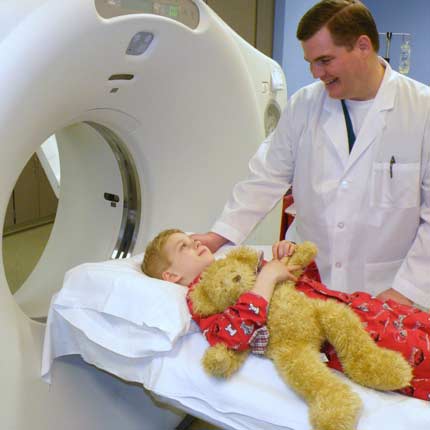
The CT scanner is typically a large machine with a hole, or short tunnel, in the center. A moveable examination table slides into and out of this tunnel. In the center of the machine, the x-ray tube and electronic x-ray detectors are located opposite each other on a ring, called a gantry, which rotates around the patient. The computer that processes the imaging information and monitor are located in a separate room where the CT technologist sits. The technologist will always be able to see your child in the CT scanner.
How does the procedure work?
In many ways, CT scanning is like other x-ray examinations. X-rays are a form of radiation, like light or radio waves that can be directed at the body. Different body parts absorb the x-rays in varying degrees.
In a conventional x-ray exam, a small burst of radiation passes through the body, recording an image on photographic film or a special image recording plate. Bones appear white on the x-ray; soft tissues show up in shades of gray and air appears black.
With CT scanning, numerous x-ray beams and a set of electronic x-ray detectors rotate around the patient. At the same time, the examination table is moving through the scanner, so that the x-ray beam follows a spiral path. A special computer program processes this series of pictures, or slices of the body, to create two-dimensional cross-sectional images, which are then displayed on a monitor. Special software can also generate three-dimensional (3-D) images when requested by your physician or the radiologist interpreting the exam.
CT imaging is sometimes compared to looking into a loaf of bread by cutting the loaf into thin slices. When the image slices are reassembled by computer software, the result is a very detailed multidimensional view of the body's interior.
Refinements in detector technology allow new CT scanners to obtain multiple slices in a single rotation. These scanners, called "multislice CT" or "multidetector CT," allow thinner slices to be obtained, resulting in more detail of the body, in a shorter period of time.
Modern CT scanners are so fast that they can scan through large sections of the body in just a few seconds. Such speed is beneficial for all patients but especially children, the elderly and critically ill.
Some CT exams use a contrast material to enhance visibility in the body area under examination.
How is the procedure performed?
The technologist begins by positioning the patient on the CT examination table, usually lying flat on his/her back, but sometimes in other positions. Straps and pillows may be used to help the patient maintain the correct position and to hold still during the exam.
You should encourage your child to report any discomfort during positioning because it is important to keep very still during the exam. Once the child is correctly positioned, the CT technologist will go to the adjacent room, seen through the window, to begin the scan.
The exam may use contrast material, depending on the type of exam. If so, it will be swallowed, injected through an intravenous line (IV) or, rarely, administered by enema.
Next, the table will move quickly through the scanner to determine the correct starting position for the scans. Then, the table will move slowly through the machine for the actual CT scan. Depending on the type of CT scan, the machine may make several passes.
Patients may be asked to hold their breath during the scanning, especially if the chest is being scanned.
Most children older than six years are able to hold their breath long enough to complete the scan although they may need coaching and practice. Younger children may not be able to hold their breath long enough to complete the scan. It is better in this circumstance to have young children breathe quietly and regularly during the scan.
When the examination is completed, the patient will be asked to wait until the technologist determines that the images are of high enough quality for the radiologist to read.
What will my child experience during and after the procedure?
CT exams are generally painless, fast, and easy. Multidetector CT reduces the amount of time that the patient needs to lie still.
Though the scanning itself causes no pain, your child may experience some discomfort from having to remain still for several minutes.
If an intravenous contrast material is used, your child will feel a slight pin prick when the IV is inserted, usually into the hand or arm. The child may have a warm, flushed sensation during the injection of the contrast materials and a metallic taste in his/her mouth that lasts for a few minutes. Occasionally, a patient will develop itching and hives, which can be relieved with medication, if necessary. If your child becomes light-headed or experiences difficulty breathing, you should notify the technologist or nurse, as it may indicate a more severe allergic reaction. If your child experiences any kind of reaction to the intravenous contrast, it is important that you and/or your child remember to tell health care providers in the future.
If the contrast material is swallowed, your child may find the taste mildly unpleasant even if mixed with soda or juice; however, most patients can easily tolerate the oral contrast. Your child can expect to experience a sense of abdominal fullness and an increasing need to expel the liquid in the rare situation where the contrast material is given by enema. In this case, encourage your child to be patient, as the mild discomfort will not last long.
When your child enters the scanner, special lights may be used to ensure that he/she is properly positioned. With modern CT scanners, your child will hear only slight buzzing, clicking and whirring sounds as the CT scanner revolves around him/her during the imaging process.
The technologist will leave the room to perform the CT scan. However, the technologist will be able to see, hear and speak with your child at all times. A parent may be allowed in the room but will be required to wear a lead apron to prevent radiation exposure. The radiation dose directly outside of the CT scanner itself is very low. If you suspect you may be pregnant, however, it would be better for someone else to be with your child.
Some imaging facilities may use general anesthesia or conscious sedation in young children who are unable to hold still. In this case you may be permitted to stay in the exam room until your child has fallen asleep. There may be a somewhat longer wait after the exam to be sure that your child is reasonably alert.
Generally, after a CT exam, your child can return to his/her normal activities. If your child received some form of sedation for the exam, you and your child will stay in the department for a recovery period and will be given instructions on any limitations in activity for the day.
Who interprets the results and how do we get them?
A radiologist, a doctor specially trained to supervise and interpret radiology exams, will analyze the images. The radiologist will send an official report to the doctor who ordered the exam.
You may need a follow-up exam. If so, your doctor will explain why. Sometimes a follow-up exam further evaluates a potential issue with more views or a special imaging technique. It may also see if there has been any change in an issue over time. Follow-up exams are often the best way to see if treatment is working or if a problem needs attention.
What are the benefits vs. risks?
Benefits
- Using a multidetector CT unit to examine children is faster than the older CT scanners, reducing the need for sedation and general anesthesia.
- New technologies that will make even faster scanning possible are becoming increasingly available. For children this means shorter imaging times and less time required to hold still in order to produce clear images. Also, shorter scan times will make it easier for children to hold their breath during critical parts of the exam.
- CT scanning is painless, noninvasive, and accurate.
- A major advantage of CT is its ability to image bone, soft tissue, and blood vessels all at the same time.
- Unlike conventional x-rays, CT scanning provides very detailed images of many types of tissue as well as the lungs, bones, and blood vessels.
- CT exams are fast and simple. In emergency cases, they can reveal internal injuries and bleeding quickly enough to help save lives.
- CT has been shown to be a cost-effective imaging tool for a wide range of clinical problems.
- CT is less sensitive to patient movement than MRI.
- Unlike MRI, an implanted medical device of any kind will not prevent you from having a CT scan.
- CT imaging provides real-time imaging, making it a good tool for guiding minimally invasive procedures such as needle biopsies and needle aspirations of many areas of the body, particularly the lungs, abdomen, pelvis and bones. Sometimes ultrasound is substituted for CT as a method of imaging in these procedures in children.
- A diagnosis determined by CT scanning may eliminate the need for exploratory surgery and surgical biopsy.
- No radiation remains in a patient's body after a CT exam.
- The x-rays used for CT scanning should have no immediate side effects.
Risks
- The risk of serious allergic reaction to contrast materials that contain iodine is rare in children, and almost always mild, and radiology departments are well-equipped to deal with them.
- Radiation is necessary to obtain CT images. It is known that high levels of radiation may cause cancer. However, CT scans result in a low-level exposure. Whether such levels cause cancer is debatable but because it is possible, every effort is made to limit the amount of radiation children may receive from a CT scan. One of the best ways of limiting radiation exposure is to avoid CT scans that are not clearly needed. Another strategy is to consider other tests, such as MRI or ultrasound which might give the same information. Other measures are to restrict the area scanned as much as possible and to "fine tune" the CT settings based on the reason for the exam, the body area being examined, and the child's size. Radiologists generally attempt to use the lowest radiation dose that will provide the needed diagnostic information. The benefit of an accurate diagnosis far outweighs the risk. See the Radiation Dose page for more information.
- There always is a risk of complications from general anesthesia or sedation. Every measure will be taken to protect the welfare of your child, including close monitoring.
- Because children are more sensitive to radiation, they should have a CT study only if it is essential for making a diagnosis and should not have repeated CT studies unless absolutely necessary.
What are the limitations of Pediatric CT?
A person who is very large may not fit into the opening of a conventional CT scanner. Or, they may be over the weight limit—usually 450 pounds—for the moving table.
Other imaging methods such as ultrasound or magnetic resonance (MR) imaging can provide pictures of certain areas of the body that sometimes are as good as or better than those obtained by CT scanning. Working together, your primary care physician or pediatrician and the radiologist will decide which type of examination is best for your child.
Additional Information and Resources
The Image Gently Alliance: imagegently.org
This page was reviewed on May 01, 2023