Intravenous Pyelogram (IVP)
Intravenous pyelogram (IVP) is an x-ray exam that uses an injection of contrast material to evaluate your kidneys, ureters and bladder and help diagnose blood in the urine or pain in your side or lower back. An IVP may provide enough information to allow your doctor to treat you with medication and avoid surgery.
Inform your doctor if there's a possibility you are pregnant and discuss any recent illnesses, medical conditions, medications you're taking and allergies, especially to iodine-based contrast materials. Your doctor may instruct you to take a mild laxative the evening before the exam and to not eat or drink anything after midnight. Wear loose, comfortable clothing and leave jewelry at home. You may be asked to wear a gown.
- What is an Intravenous Pyelogram (IVP)?
- What are some common uses of the procedure?
- How should I prepare?
- What does the equipment look like?
- How does the procedure work?
- How is the procedure performed?
- What will I experience during and after the procedure?
- Who interprets the results and how do I get them?
- What are the benefits vs. risks?
- What are the limitations of IVP exams?
What is an Intravenous Pyelogram (IVP)?
An intravenous pyelogram (IVP) is an x-ray examination of the kidneys, ureters and urinary bladder that uses iodinated contrast material injected into veins.
An x-ray exam helps doctors diagnose and treat medical conditions. It exposes you to a small dose of ionizing radiation to produce pictures of the inside of the body. X-rays are the oldest and most often used form of medical imaging.
When contrast material is injected into a vein in the patient's arm, it travels through the blood stream and collects in the kidneys and urinary tract, turning these areas bright white on the x-ray images. An IVP allows the radiologist to view and assess the anatomy and function of the kidneys, ureters and the bladder.
What are some common uses of the procedure?
An intravenous pyelogram examination helps the radiologist assess abnormalities in the urinary system, as well as how quickly and efficiently the patient's system is able to handle fluid waste.
The exam is used to help diagnose symptoms such as blood in the urine or pain in the side or lower back.
The IVP exam can enable the radiologist to detect problems within the urinary tract resulting from:
- kidney stones
- enlarged prostate
- tumors in the kidney, ureters or urinary bladder
- scarring from urinary tract infection
- surgery on the urinary tract
- congenital anomalies of the urinary tract
How should I prepare?
Your doctor will give you detailed instructions on how to prepare for your IVP study.
You will likely be instructed not to eat or drink after midnight on the night before your exam. You may also be asked to take a mild laxative (in either pill or liquid form) the evening before the procedure.
Tell your doctor about all the medications you take. List any allergies, especially to iodine contrast materials. Tell your doctor about recent illnesses or other medical conditions.
You may need to remove some clothing and/or change into a gown for the exam. Remove jewelry, removable dental appliances, eyeglasses, and any metal objects or clothing that might interfere with the x-ray images.
Women should always tell their doctor and technologist if they are pregnant. Doctors will not perform many tests during pregnancy to avoid exposing the fetus to radiation. If an x-ray is necessary, the doctor will take precautions to minimize radiation exposure to the baby. See the Radiation Safety page for more information about pregnancy and x-rays.
What does the equipment look like?
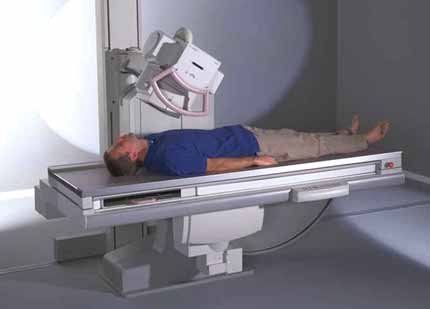
This exam typically uses a radiographic table, one or two x-ray tubes, and a video monitor. Fluoroscopy converts x-rays into video images. Doctors use it to watch and guide procedures. The x-ray machine and a detector suspended over the exam table produce the video.
How does the procedure work?
X-rays are a form of radiation like light or radio waves. X-rays pass through most objects, including the body. The technologist carefully aims the x-ray beam at the area of interest. The machine produces a small burst of radiation that passes through your body. The radiation records an image on photographic film or a special detector.
In an IVP exam, an iodine-containing contrast material is injected through a vein in the arm. The contrast material then collects in the kidneys, ureters and bladder, sharply defining their appearance in bright white on the x-ray images.
X-ray images are typically stored as digital images in an electronic archive. However, if needed, a hard film copy (similar to a photograph) or a CD-ROM disk can be made. These stored images are easily accessible and may be compared to current or prior x-ray images for diagnosis and disease management.
How is the procedure performed?
Your doctor will likely do this exam on an outpatient basis.
You will lie on the table and still x-ray images are taken. The contrast material is then injected, usually in a vein in your arm, followed by additional still images. The number of images taken depends on the reason for the examination and your anatomy.
You must hold very still and may need to hold your breath for a few seconds while the technologist takes the x-ray. This helps reduce the possibility of a blurred image. The technologist will walk behind a wall or into the next room to activate the x-ray machine.
As the contrast material is processed by the kidneys, a series of images is taken to determine the actual size of the kidneys and to image the urinary tract in action as it begins to empty. The technologist may apply a compression band around the body to better visualize the urinary structures.
When the examination is complete, the technologist may ask you to wait until the radiologist confirms they have all the necessary images.
An IVP study is usually completed within an hour. However, because some kidneys function at a slower rate, the exam may last up to four hours.
What will I experience during and after the procedure?
The IVP is usually a relatively comfortable procedure.
You will feel a minor sting as the contrast material is injected into your arm through a small needle. Some patients experience a flush of warmth, a mild itching sensation and a metallic taste in their mouth as it begins to circulate throughout their body. These common side effects usually disappear within a minute or two and are harmless. Rarely, some patients will experience an allergic reaction. Itching that persists or is accompanied by hives, can be easily treated with medication. In very rare cases, a patient may become short of breath or experience swelling in the throat or other parts of the body. These can be indications of a more serious reaction to the contrast material that should be treated promptly. Tell the radiologist immediately if you experience these symptoms as he/she is well prepared to treat this.
During the imaging process, you may be asked to turn from side to side and to hold several different positions to enable the radiologist to capture views from several angles. Near the end of the exam, you may be asked to empty your bladder so that an additional x-ray can be taken of your urinary bladder after it empties.
The contrast material used for IVP studies will not discolor your urine or cause any discomfort when you urinate.
Who interprets the results and how do I get them?
A radiologist, a doctor trained to supervise and interpret radiology examinations, will analyze the images. The radiologist will send a signed report to your primary care or referring physician who will discuss the results with you.
You may need a follow-up exam. If so, your doctor will explain why. Sometimes a follow-up exam further evaluates a potential issue with more views or a special imaging technique. It may also see if there has been any change in an issue over time. Follow-up exams are often the best way to see if treatment is working or if a problem needs attention.
What are the benefits vs. risks?
Benefits
- Imaging of the urinary tract with IVP is a minimally invasive procedure.
- IVP images provide valuable, detailed information to assist physicians in diagnosing and treating urinary tract conditions from kidney stones to cancer.
- An IVP can often provide enough information about kidney stones and urinary tract obstructions to direct treatment with medication and avoid more invasive surgical procedures.
- No radiation stays in your body after an x-ray exam.
- X-rays usually have no side effects in the typical diagnostic range for this exam.
Risks
- There is always a slight chance of cancer from excessive exposure to radiation. However, given the small amount of radiation used in medical imaging, the benefit of an accurate diagnosis far outweighs the associated risk.
- The radiation dose for this procedure varies. See the Radiation Dose page for more information.
- Contrast materials used in IVP studies can cause adverse allergic reactions in some people, sometimes requiring medical treatment.
- Women should always tell their doctor and x-ray technologist if they are pregnant. See the Radiation Safety page for more information about pregnancy and x-rays.
A Word About Minimizing Radiation Exposure
Doctors take special care during x-ray exams to use the lowest radiation dose possible while producing the best images for evaluation. National and international radiology protection organizations continually review and update the technique standards radiology professionals use.
Modern x-ray systems minimize stray (scatter) radiation by using controlled x-ray beams and dose control methods. This ensures that the areas of your body not being imaged receive minimal radiation exposure.
What are the limitations of IVP exams?
An IVP shows details of the inside of the urinary tract including the kidneys, ureters and bladder. Computed tomography (CT) or magnetic resonance imaging (MRI) may add valuable information about the functioning tissue of the kidneys and surrounding structures nearby the kidneys, ureters and bladder. Small urinary tract tumors and stones are more easily identified on these examinations.
IVP exams are not usually indicated for pregnant women.
The uses for IVP in infants and children are limited. Other tests, including ultrasound, can be used in most cases to evaluate the kidneys and bladder. In general, IVPs are rarely done in pediatric patients.
This page was reviewed on May 30, 2024