Spine MRI
Magnetic resonance imaging (MRI) of the spine uses radio waves, a magnetic field and a computer. It creates clear, detailed pictures of the spine and surrounding tissues. MRI does not use radiation and may require an injection of gadolinium contrast material. Gadolinium is less likely to cause an allergic reaction than iodine contrast material.
Tell your doctor about any health problems, recent surgeries, allergies and whether you are pregnant. The magnetic field is not harmful, but it may cause some medical devices to malfunction. Most orthopedic implants pose no risk. But, you should always tell the technologist if you have devices or metal in your body. Guidelines about eating and drinking before your exam vary between facilities. Unless you are told otherwise, take medications as usual. Leave jewelry at home and wear loose, comfortable clothing. You may be asked to wear a gown. If you have a fear of closed spaces, you may want to ask your doctor for a mild sedative before the exam.
- What is MRI of the Spine?
- What are some common uses of the procedure?
- How should I prepare?
- What does the equipment look like?
- How does the procedure work?
- How is the procedure performed?
- What will I experience during and after the procedure?
- Who interprets the results and how do I get them?
- What are the benefits vs. risks?
- What are the limitations of MRI of the Spine?
What is MRI of the Spine?
Magnetic resonance imaging (MRI) is a noninvasive test doctors use to diagnose medical conditions.
MRI uses a powerful magnetic field, radiofrequency pulses, and a computer to produce detailed pictures of internal body structures. MRI does not use radiation (x-rays).
Detailed MR images allow doctors to examine the body and detect disease.
Currently, MRI is the most sensitive imaging test available for the spine.
What are some common uses of the procedure?
MR imaging is used to assess or detect:
- Spine anatomy and alignment.
- Birth defects in the vertebrae or spinal cord.
- Trauma injury to the bone, disc, ligament or spinal cord.
- Disc and joint disease. Both are frequent causes of severe lower back pain and sciatica (back pain radiating into lower leg).
- Compression or inflammation of spinal cord and nerves.
- Infection of the vertebrae, discs, spinal cord or its coverings (meninges).
- Tumors in the vertebrae, spinal cord, nerves or surrounding soft tissues.
Spine MRI is also used to help plan procedures such as decompression of a pinched nerve, spinal fusion, or steroid injections. The steroid injections relieve pain and are usually done using x-ray guidance. Spine MRI detects other possible causes of back pain such as compression fracture, and bone swelling. It is also used to monitor changes in the spine after an operation, such as scarring or infection.
How should I prepare?
You will need to change into a hospital gown. This is to prevent artifacts appearing on the final images and to comply with safety regulations related to the strong magnetic field.
Guidelines about eating and drinking before an MRI vary between specific exams and facilities. Take food and medications as usual unless your doctor tells you otherwise.
Some MRI exams use an injection of contrast material. The doctor may ask if you have asthma or allergies to contrast material, drugs, food, or the environment. MRI exams commonly use a contrast material called gadolinium. Doctors can use gadolinium in patients who are allergic to iodine contrast. A patient is much less likely to be allergic to gadolinium than to iodine contrast. However, even if the patient has a known allergy to gadolinium, it may be possible to use it after appropriate pre-medication. For more information on allergic reactions to gadolinium contrast, please consult the ACR Manual on Contrast Media.
Tell the technologist or radiologist if you have any serious health problems or recent surgeries. Some conditions, such as severe kidney disease, may mean that you cannot safely receive gadolinium. You may need a blood test to confirm your kidneys are functioning normally.
Infants and young children often require sedation or anesthesia to complete an MRI exam without moving. This depends on the child's age, intellectual development, and the type of exam. Sedation can be provided at many facilities. A specialist in pediatric sedation or anesthesia should be available during the exam for your child's safety. You will be told how to prepare your child.
Some facilities may have personnel who work with children to help avoid the need for sedation or anesthesia. They may prepare children by showing them a model MRI scanner and playing the noises they might hear during the exam. They also answer any questions and explain the procedure to relieve anxiety. Some facilities also provide goggles or headsets so the child can watch a movie during the exam. This helps the child stay still and allows for good quality images.
Leave all jewelry and other accessories at home or remove them prior to the MRI scan. Metal and electronic items are not allowed in the exam room. They can interfere with the magnetic field of the MRI unit, cause burns, or become harmful projectiles. These items include:
- jewelry, watches, credit cards, and hearing aids, all of which can be damaged
- pins, hairpins, metal zippers, and similar metallic items, which can distort MRI images
- removable dental work
- pens, pocketknives, and eyeglasses
- body piercings
- mobile phones, electronic watches, and tracking devices.
In most cases, an MRI exam is safe for patients with metal implants, except for a few types. People with the following implants may not be scanned and should not enter the MRI scanning area without first being evaluated for safety:
- some cochlear (ear) implants
- some types of clips used for brain aneurysms
- some types of metal coils placed within blood vessels
- some older cardiac defibrillators and pacemakers
- vagal nerve stimulators
Tell the technologist if you have medical or electronic devices in your body. These devices may interfere with the exam or pose a risk. Many implanted devices will have a pamphlet explaining the MRI risks for that device. If you have the pamphlet, bring it to the attention of the scheduler before the exam. MRI cannot be performed without confirmation and documentation of the type of implant and MRI compatibility. You should also bring any pamphlet to your exam in case the radiologist or technologist has any questions.
If there is any question, an x-ray can detect and identify any metal objects. Metal objects used in orthopedic surgery generally pose no risk during MRI. However, a recently placed artificial joint may require the use of a different imaging exam.
Tell the technologist or radiologist about any shrapnel, bullets, or other metal that may be in your body. Foreign bodies near and especially lodged in the eyes are very important because they may move or heat up during the scan and cause blindness. Dyes used in tattoos may contain iron and could heat up during an MRI scan. This is rare. The magnetic field will usually not affect tooth fillings, braces, eyeshadows, and other cosmetics. However, these items may distort images of the facial area or brain. Tell the radiologist about them.
Anyone accompanying a patient into the exam room must also undergo screening for metal objects and implanted devices.
What does the equipment look like?
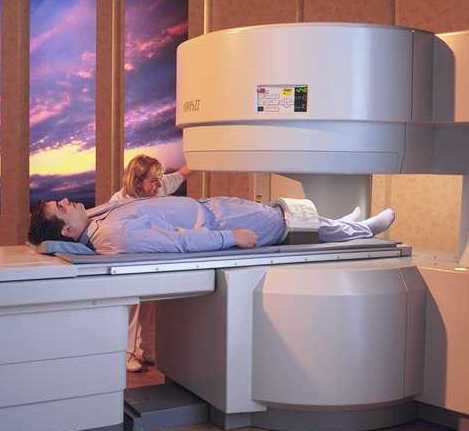
The traditional MRI unit is a large cylinder-shaped tube surrounded by a circular magnet. You will lie on a table that slides into a tunnel towards the center of the magnet.
Some MRI units, called short-bore systems, are designed so that the magnet does not completely surround you. Some newer MRI machines have a larger diameter bore, which can be more comfortable for larger patients or those with claustrophobia. "Open" MRI units are open on the sides. They are especially helpful for examining larger patients or those with claustrophobia. Open MRI units can provide high quality images for many types of exams. Open MRI may not be used for certain exams. For more information, consult your radiologist.
How does the procedure work?
Unlike x-ray and computed tomography (CT) exams, MRI does not use radiation. Instead, radio waves re-align hydrogen atoms that naturally exist within the body. This does not cause any chemical changes in the tissues. As the hydrogen atoms return to their usual alignment, they emit different amounts of energy depending on the type of tissue they are in. The scanner captures this energy and creates a picture using this information.
In most MRI units, the magnetic field is produced by passing an electric current through wire coils. Other coils are inside the machine and, in some cases, are placed around the part of the body being imaged. These coils send and receive radio waves, producing signals that are detected by the machine. The electric current does not come into contact with the patient.
A computer processes the signals and creates a series of images, each of which shows a thin slice of the body. The radiologist can study these images from different angles.
MRI is often able to tell the difference between diseased tissue and normal tissue better than x-ray, CT, and ultrasound.
How is the procedure performed?
MRI exams may be done on an outpatient basis.
The technologist will position you on the moveable exam table. They may use straps and bolsters to help you stay still and maintain your position.
The technologist may place devices that contain coils capable of sending and receiving radio waves around or next to the area of the body under examination.
MRI exams generally include multiple runs (sequences), some of which may last several minutes. Each run will create a different set of noises.
Depending on where your symptoms are, only part of the spine may be scanned. For example, the cervical (neck) portion, the thoracic (chest) spine or the lumbar (lower) spine. Gadolinium contrast material may be used when looking for infection, tumors or recurrent disk issues after a surgery.
If your exam uses a contrast material, a doctor, nurse, or technologist will insert an intravenous catheter (IV line) into a vein in your hand or arm. They will use this IV to inject the contrast material.
You will be placed into the magnet of the MRI unit. The technologist will perform the exam while working at a computer outside of the room. You will be able to talk to the technologist via an intercom.
When the exam is complete, the technologist may ask you to wait while the radiologist checks the images in case more are needed.
The technologist will remove your IV line after the exam is over and place a small dressing over the insertion site.
The entire exam is usually completed within 30 to 60 minutes. This will depend on whether part or all of the spine is scanned. If contrast material is used, more images will be taken after the injection. This will add another 15 to 20 minutes to the total scan time.
What will I experience during and after the procedure?
Most MRI exams are painless. However, some patients find it uncomfortable to remain still. Others may feel closed-in (claustrophobic) while in the MRI scanner. The scanner can be noisy.
It is normal for the area of your body being imaged to feel slightly warm. If it bothers you, tell the radiologist or technologist. It is important that you remain perfectly still while the images are being taken. This is typically only a few seconds to a few minutes at a time. You will know when images are being recorded because you will hear and feel loud tapping or thumping sounds. The coils that generate the radio waves make these sounds when they are activated. You will be provided with earplugs or headphones to reduce the noise made by the scanner. You may be able to relax between imaging sequences. However, you will need to keep the same position as much as possible without moving.
You will usually be alone in the exam room. However, the technologist will be able to see, hear, and speak with you at all times using a two-way intercom. They will give you a “squeeze-ball” that alerts the technologist that you need attention right away. Many facilities allow a friend or parent to stay in the room if they have also been screened for safety.
Children will be given appropriately sized earplugs or headphones during the exam. Music may be played through the headphones to help pass the time. MRI scanners are air-conditioned and well-lit.
In some cases, IV injection of contrast material may be given before the images are obtained. The IV needle may cause you some discomfort and you may experience some bruising. There is also a very small chance of skin irritation at the site of the IV tube insertion. Some patients may have a temporary metallic taste in their mouth after the contrast injection.
If you do not require sedation, no recovery period is necessary. You may resume your usual activities and normal diet immediately after the exam. On very rare occasions, a few patients experience side effects from the contrast material. These may include nausea, headache, and pain at the site of injection. It is very rare that patients experience hives, itchy eyes, or other allergic reactions to the contrast material. If you have allergic symptoms, tell the technologist. A radiologist or other doctor will be available for immediate assistance.
Who interprets the results and how do I get them?
A radiologist, a doctor trained to supervise and interpret radiology exams, will analyze the images. The radiologist will send a signed report to your primary care or referring physician, who will share the results with you.
You may need a follow-up exam. If so, your doctor will explain why. Sometimes a follow-up exam further evaluates a potential issue with more views or a special imaging technique. It may also see if there has been any change in an issue over time. Follow-up exams are often the best way to see if treatment is working or if a problem needs attention.
What are the benefits vs. risks?
Benefits
- MRI is a noninvasive imaging technique that does not involve exposure to radiation.
- MR images of the spine are clearer and more detailed than images obtained with other imaging methods. MRI can show spinal abnormalities, injuries and disease that may not be seen with other methods. MRI is the best available method to visualize the spinal cord and nerves.
- MRI can detect abnormalities that might be obscured by bone with other imaging methods.
- The MRI gadolinium contrast material is less likely to cause an allergic reaction than the iodine-based contrast materials used for x-rays and CT scanning.
- MRI is very useful for evaluating spinal injuries. It helps diagnose or rule out acute spinal cord compression when a physical exam shows muscle weakness or paralysis. MRI is the best available method to evaluate ligament injuries.
- MRI is able to detect subtle changes in the vertebral column that may be an early sign of infection or tumor. MRI is more sensitive than CT scanning for evaluating tumors, abscesses and other soft tissue masses near the spinal cord.
- MRI is the preferred method for assessing potential complications of surgery, including bleeding, scarring, infection and re-appearance of a herniated disk.
Risks
- The MRI exam poses almost no risk to the average patient when appropriate safety guidelines are followed.
- If sedation is used, there is a risk of using too much. However, your vital signs will be monitored to minimize this risk.
- The strong magnetic field is not harmful to you. However, it may cause implanted medical devices to malfunction or distort the images.
- Nephrogenic systemic fibrosis is a recognized complication related to injection of gadolinium contrast. It is exceptionally rare with the use of newer gadolinium contrast agents. It usually occurs in patients with serious kidney disease. Your doctor will carefully assess your kidney function before considering a contrast injection.
- There is a very slight risk of an allergic reaction if your exam uses contrast material. Such reactions are usually mild and controlled by medication. If you have an allergic reaction, a doctor will be available for immediate assistance.
- Although there are no known health effects, evidence has shown that very small amounts of gadolinium can remain in the body, particularly the brain, after multiple MRI exams. This is most likely to occur in patients receiving multiple MRI exams over their lifetime for monitoring chronic or high-risk health conditions. The contrast agent is mostly eliminated from the body through the kidneys. If you are a patient in this category, consult with your doctor about the possibility of gadolinium retention, as this effect varies from patient to patient.
- IV contrast manufacturers indicate mothers should not breastfeed their babies for 24-48 hours after contrast material is given. However, the most recent American College of Radiology (ACR) Manual on Contrast Media reports that studies show the amount of contrast absorbed by the infant during breastfeeding is extremely low. For further information please consult the ACR Manual on Contrast Media and its references.
What are the limitations of MRI of the Spine?
High-quality images depend on your ability to remain perfectly still and follow breath-holding instructions while the images are being recorded. If you are anxious, confused or in severe pain, you may find it difficult to lie still during imaging.
A person who is very large may not fit into certain types of MRI machines. There are weight limits on the scanners.
Implants and other metallic objects can make it difficult to obtain clear images. Patient movement can have the same effect.
A very irregular heartbeat may affect the quality of images. This is because some techniques time the imaging based on the electrical activity of the heart.
MRI is generally not recommended for seriously injured patients. However, this decision is based on clinical judgment. This is because traction devices and life support equipment may distort the MR images. As a result, they must be kept away from the area to be imaged. Some trauma patients, however, may need MRI.
Present data show no convincing evidence that non contrast MRI harms the fetus of a pregnant woman. However, if the need for the exam is not time sensitive your doctor may delay the exam until after delivery. MRI gadolinium contrast agents are generally avoided during pregnancy except in very specific circumstances. Your doctor will discuss the benefits and risks of any MRI procedure with you. Doctors may perform MRI after the first trimester to assess the fetus for findings that are not fully evaluated by ultrasound.
An MRI exam typically costs more and may take more time than other imaging exams. Talk to your insurance provider if you have concerns about the cost of MRI.
In some patients, vertebral fractures may be better detected by CT scan.
This page was reviewed on April 15, 2022