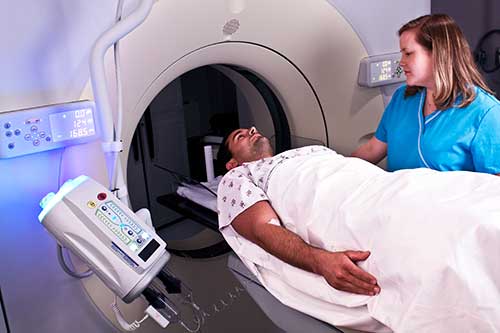
Coronary CTA
Coronary computed tomography angiography (also called coronary CT angiography or CCTA) uses an injection of iodine-containing contrast material and CT scanning to examine the arteries that supply blood to the heart and determine whether they have been narrowed. The images generated during a CT scan can be reformatted to create three-dimensional (3D) images that may be viewed on a monitor, printed on film or by a 3D printer, or transferred to electronic media.
Tell your doctor if there's a possibility you are pregnant and discuss any recent illnesses, medical conditions, medications you're taking, and allergies. You will be instructed not to eat or drink anything several hours beforehand and to avoid caffeinated products, Viagra or similar medication. If you have a known allergy to contrast material, your doctor may prescribe medications to reduce the risk of an allergic reaction. These medications must be taken at multiple intervals beginning 13 hours prior to your exam. Leave jewelry at home and wear loose, comfortable clothing. You may be asked to wear a gown. If you are breastfeeding, talk to your doctor about how to proceed.
- What is coronary CTA?
- What are some common uses of the procedure?
- How should I prepare?
- What does the equipment look like?
- How does the procedure work?
- How is the procedure performed?
- What will I experience during and after the procedure?
- Who interprets the results and how do I get them?
- What are the benefits vs. risks?
- What are the limitations of coronary CTA?
What is coronary CTA?
Coronary computed tomography angiography (CCTA) is a heart imaging test that helps determine if plaque buildup has narrowed the coronary arteries, the blood vessels that supply the heart. Plaque is made of various substances such as fat, cholesterol and calcium that deposit along the inner lining of the arteries. Plaque, which builds up over time, can reduce or in some cases completely block blood flow. Patients undergoing a CCTA scan receive an iodine-containing contrast material as an intravenous (IV) injection to ensure the best possible images of the heart blood vessels.
Computed tomography, more commonly known as a CT or CAT scan, is a diagnostic medical imaging test. Like traditional x-rays, it produces multiple images or pictures of the inside of the body.
A CT scan generates images that can be reformatted in multiple planes. It can even generate three-dimensional images. Your doctor can review these images on a computer monitor, print them on film or via a 3D printer, or transfer them to a CD or DVD.
CT images of internal organs, bones, soft tissue, and blood vessels provide greater detail than traditional x-rays. This is especially true for soft tissues and blood vessels.
What are some common uses of the procedure?
Many physicians advocate the careful use of CCTA for patients who have:
- suspected abnormal anatomy of the coronary arteries.
- low or intermediate risk for coronary artery disease, including patients who have chest pain and normal, non-diagnostic or unclear lab and ECG results.
- low to intermediate risk atypical chest pain in the emergency department.
- non-acute chest pain.
- new or worsening symptoms with a previous normal stress test result.
- unclear or inconclusive stress test results.
- new onset heart failure with reduced heart function and low or medium risk for coronary artery disease.
- intermediate risk of coronary artery disease before non-coronary cardiac surgery.
- coronary artery bypass grafts.
For patients meeting the above indications, CCTA can provide important information about the presence and extent of plaque in the coronary arteries. Apart from identifying coronary artery narrowing as the cause of chest discomfort, it can also detect other possible causes of symptoms, such as a collapsed lung, blood clot in the vessels leading to the lungs, or aortic abnormalities. Your primary care physician or cardiac specialist, in consultation with a radiologist who would perform the test, will determine whether CCTA is appropriate for you.
How should I prepare?
Wear comfortable, loose-fitting clothing to your exam. You may need to change into a gown for the procedure.
Metal objects, including jewelry, eyeglasses, dentures, and hairpins, may affect the CT images. Leave them at home or remove them prior to your exam. Some CT exams will require you to remove hearing aids and removable dental work. Women will need to remove bras containing metal underwire. You may need to remove any piercings, if possible.
Your doctor may instruct you to not eat or drink anything for a few hours before your exam if it will use contrast material. Tell your doctor about all medications you are taking and if you have any allergies. If you have a known allergy to contrast material, your doctor may prescribe medications (usually a steroid) to reduce the risk of an allergic reaction. To avoid unnecessary delays, contact your doctor well before the date of your exam.
Also tell your doctor about any recent illnesses or other medical conditions and whether you have a history of heart disease, asthma, diabetes, kidney disease, or thyroid problems. Any of these conditions may increase the risk of an adverse effect.
On the day before and day of your exam, you may be asked to avoid:
- diet pills and caffeinated drinks such as coffee, tea, energy drinks or sodas. These may increase heart rate and limit the ability of the exam to evaluate for plaque in the coronary arteries.
- Viagra or any similar medication. They are not compatible with the medications you will receive during the procedure.
On the night before the procedure, you may be asked to take a beta blocker medication to lower your heart rate to optimize the quality of the exam.
Your child may be asked not to eat or drink anything for several hours beforehand, especially if a sedative or anesthesia will be used in the exam. In general, children who have recently been ill will not be sedated or anesthetized. If this is the case, or if you suspect that your child may be getting sick, you should talk with your physician about rescheduling the CT exam.
You should also inform your physician of any medications your child is taking and if he/she has any allergies, especially to intravenous (IV) or oral contrast materials. The allergy information should also be discussed with the CT technologist or nurse at the time of the CT examination. If your child has a known contrast material allergy, you should inform the doctor and technologist prior to the exam.
Also inform your doctor of any recent illnesses or other medical conditions your child may have, and if there is a history of heart disease, asthma, diabetes, kidney disease or thyroid problems. Any of these conditions may influence the decision on whether contrast material will be given to your child for the CT examination.
Talk to your doctor if you have questions about the instructions you've been given.
Women should always inform their physician and the CT technologist if there is any possibility that they may be pregnant. See the CT Safety During Pregnancy page for more information.
If you are breastfeeding at the time of the exam, ask your doctor how to proceed. It may help to pump breast milk ahead of time. Keep it on hand for use until all contrast material has cleared from your body (about 24 hours after the test). However, the most recent American College of Radiology (ACR) Manual on Contrast Media reports that studies show the amount of contrast absorbed by the infant during breastfeeding is extremely low. For further information please consult the ACR Manual on Contrast Media and its references.
What does the equipment look like?
The CT scanner is typically a large, donut-shaped machine with a short tunnel in the center. You will lie on a narrow table that slides in and out of this short tunnel. Rotating around you, the x-ray tube and electronic x-ray detectors are located opposite each other in a ring, called a gantry. The computer workstation that processes the imaging information is in a separate control room. This is where the technologist operates the scanner and monitors your exam in direct visual contact. The technologist will be able to hear and talk to you using a speaker and microphone.
CCTA is very much like a normal CT scan. The only difference is the speed of the CT scanner and the use of a heart monitor to determine your heart rate.
How does the procedure work?
During the examination, x-rays pass through the body and are picked up by special detectors in the scanner. Typically, higher numbers (especially 64 or more) of these detectors result in clearer final images. For that reason, CCTA often is referred to as multi-detector or multi-slice CT scanning. The information collected during the CCTA examination is used to identify the coronary artery anatomy, plaque, narrowing of the vessel, and, in certain cases, heart function. The radiologist will use the computer to create three-dimensional images and images in various planes to completely evaluate the heart and coronary arteries.
Procedures use contrast material to clearly define the blood vessels being examined by making them appear bright white.
How is the procedure performed?
The nurse will give you a gown to wear during the procedure.
The technologist will clean three small areas of your chest and place electrodes (small, sticky discs) on these areas. Men may require a small area of hair to be shaved on their chest to help the electrodes stick. The electrodes are attached to an electrocardiograph (ECG) monitor, which shows your heart's electrical activity during the test.
A nurse or technologist will insert an intravenous (IV) line into a vein in your arm to administer contrast material during your procedure. While in the CT scanner, you may be given a beta blocker medication through the same IV line or by mouth to help slow your heart rate in order to improve image quality. Nitroglycerin, to dilate and improve visualization of the coronary arteries, may also be administered as a tablet, a spray underneath your tongue or a patch on your skin.
While lying on the scanning table, you may be asked to raise your arms over your head for the duration of the exam. This will help improve image quality.
Next, the table will move quickly through the scanner to determine the correct starting position for the scans. Then, the table will move slowly through the machine for the actual CT scan. Depending on the type of CT scan, the machine may make several passes.
The technologist may ask you to hold your breath during the scanning. Any motion, including breathing and body movements, can lead to artifacts on the images. This loss of image quality can resemble the blurring seen on a photograph taken of a moving object.
Inform your doctor if you have problems holding your breath for 5 to 15 seconds. Breathing during the scan creates blurring on the images and can result in an inconclusive exam.
When the exam is complete, the technologist will ask you to wait until they verify that the images are of high enough quality for accurate interpretation by the radiologist.
The doctor or nurse will remove your IV line before you go home.
Including all preparations, the CCTA scan usually takes about 15 minutes if the heart rate is slow and steady. It may take longer if the baseline heart rate is fast and beta-blocker is given to slow it down. If the beta-blocker is given by mouth it generally will require at least one hour to take effect. If the medication is injected into a vein (intravenously), it may still require multiple doses and up to 20 minutes to reach the slower heart rate.
What will I experience during and after the procedure?
Other than the needle stick when the IV line is placed, most CT exams are fast, easy and painless.
Though the scan is painless, you may have some discomfort from remaining still for several minutes or from placement of an IV. If you have a hard time staying still, are very nervous, anxious, or in pain, you may find a CT exam stressful. The technologist or nurse, under the direction of a doctor, may offer you some medication to help you tolerate the CT exam.
If the exam uses iodinated contrast material, your doctor will screen you for chronic or acute kidney disease. The doctor may administer contrast material intravenously (by vein), so you will feel a pin prick when the nurse inserts the needle into your vein. You may feel warm or flushed as the contrast is injected. You also may have a metallic taste in your mouth. This will pass. You may feel a need to urinate. However, these are only side effects of the contrast injection, and they subside quickly.
The medication given to slow the heart rate has been known to cause some patients to feel dizzy when they stand suddenly due to a lowering of blood pressure. Therefore, you will often be asked to sit up slowly on the table prior to standing. The dizziness is slight and only happens rarely. You may also have your blood pressure taken before the exam, during and following the examination if medications are given. The nitroglycerin medication may also give you a headache; this is not dangerous and will wear off quickly.
When you enter the CT scanner, you may see special light lines projected onto your body. These lines help ensure that you are in the correct position on the exam table. With modern CT scanners, you may hear slight buzzing, clicking and whirring sounds. These occur as the CT scanner's internal parts, not usually visible to you, revolve around you during the imaging process.
You will be alone in the exam room during the CT scan, unless there are special circumstances. For example, sometimes a parent wearing a lead shield may stay in the room with their child. However, the technologist will always be able to see, hear and speak with you through a built-in intercom system.
After a CT exam, the technologist will remove your intravenous line. They will cover the tiny hole made by the needle with a small dressing. You can return to your normal activities immediately.
Who interprets the results and how do I get them?
A radiologist, a doctor specially trained to supervise and interpret radiology exams, will analyze the images. The radiologist will send an official report to the doctor who ordered the exam.
If you are actively having chest pain, your results will be given to the emergency room doctor by the radiologist, and a preliminary result will be reported right away.
You may need a follow-up exam. If so, your doctor will explain why. Sometimes a follow-up exam further evaluates a potential issue with more views or a special imaging technique. It may also see if there has been any change in an issue over time. Follow-up exams are often the best way to see if treatment is working or if a problem needs attention.
What are the benefits vs. risks?
Benefits
- CCTA is not invasive. An alternative test, cardiac catheterization with a coronary angiogram, is invasive, has more complications related to the placement of a long catheter into the groin or wrist arteries extending all the way to the heart, and the movement of the catheter in the blood vessels. Invasive catheterization requires more time for the patient to recover.
- A major advantage of CT is that it is able to view bone, soft tissue and blood vessels all at the same time. It is therefore suited to identify other reasons for your discomfort such as an injury to the aorta or a blood clot in the lungs.
- Unlike conventional x-rays, CT scanning provides very detailed images of many types of tissue.
- CT examinations are fast and simple.
- CT has been shown to be cost-effective for a wide range of medical problems.
- CT is less sensitive to patient movement than MRI.
- Unlike MRI, an implanted medical device of any kind will not prevent you from having a CT scan.
- No radiation remains in a patient's body after a CT exam.
- The x-rays used for CT scanning should have no immediate side effects.
Risks
- In some people with abnormal kidney function, the contrast material used in CT scanning may worsen kidney function.
- If contrast material leaks out from the vessel being injected and spreads under the skin where the IV is placed, skin damage or damage to blood vessels and nerves, though unlikely, can result. If you feel any pain in your arm at the location of the IV during contrast material injection, you should immediately inform the technologist.
- There is always a slight chance of cancer from excessive exposure to radiation. However, the benefit of an accurate diagnosis far outweighs the risk involved with CT scanning.
- The radiation dose for this procedure varies. See the Radiation Dose page for more information.
- Women should always tell their doctor and x-ray or CT technologist if there is any chance they are pregnant. See the Radiation Safety page for more information about pregnancy and x-rays.
- Doctors do not generally recommend CT scanning for pregnant women unless medically necessary because of potential risk to the unborn baby.
- IV contrast manufacturers indicate mothers should not breastfeed their babies for 24-48 hours after contrast material is given. However, the most recent American College of Radiology (ACR) Manual on Contrast Media reports that studies show the amount of contrast absorbed by the infant during breastfeeding is extremely low. For further information please consult the ACR Manual on Contrast Media and its references.
- The risk of serious allergic reaction to contrast materials that contain iodine is rare, and radiology departments are well-equipped to deal with them.
What are the limitations of coronary CTA?
A person who is very large may not fit into the opening of a conventional CT scanner. Or, they may be over the weight limit—usually 450 pounds—for the moving table.
Patients who are extremely overweight or who have abnormal heart rhythms may not be good candidates for this test because image quality may be compromised.
Unlike CCTA, which is only a diagnostic test, invasive coronary angiography can be used for both diagnosis and treatment in a single session. If a narrowing or blockage is found during a CCTA, it cannot be treated at the same time. Patients with a high risk of coronary artery disease and typical symptoms might undergo coronary angiography instead of CCTA because they are more likely to need treatment.
CCTA can be difficult to read if there are many areas of old, calcified (hardened) plaque, which can be the case in older patients.
This page was reviewed on March 11, 2024