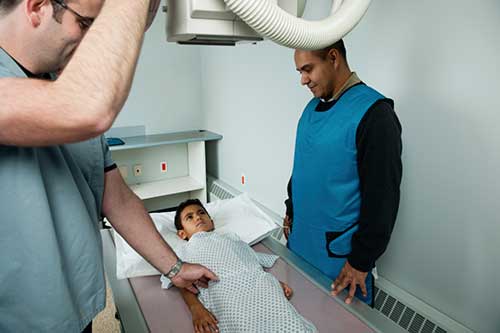
Pediatric VCUG
A pediatric voiding cystourethrogram (VCUG) uses fluoroscopy – a form of real-time x-ray – to examine a child's urinary bladder and lower urinary tract. Exam results allow your physician to determine whether your child's condition requires no therapy, medication, or surgery.
Tell your doctor about your child's recent illnesses, medical conditions, medications, and allergies, especially to contrast material. Your child should wear loose, comfortable clothing and may be asked to wear a gown. Little to no special preparation is required for this procedure and sedation is rarely needed. However, it's best to explain to your child what will happen during the exam so they will know what to expect, especially in regard to having a tube inserted into their urinary bladder.
- What is a pediatric VCUG?
- What are some common uses of the procedure?
- How should we prepare for a voiding cystourethrogram?
- What does the equipment look like?
- How does the procedure work?
- How is the voiding cystourethrogram performed?
- What will my child experience during and after the procedure?
- Who interprets the results and how do we get them?
- What are the benefits vs. risks?
- What are the limitations of a pediatric VCUG?
- Additional Information and Resources
What is a pediatric VCUG?
A pediatric voiding cystourethrogram (VCUG) is an x-ray examination of a child's urinary bladder and urinary tract that uses a special form of x-ray called fluoroscopy and a contrast material.
An x-ray exam helps doctors diagnose and treat medical conditions. It exposes you to a small dose of ionizing radiation to produce pictures of the inside of the body. X-rays are the oldest and most often used form of medical imaging.
Fluoroscopy makes it possible to see internal organs in motion. When the bladder is filled with and then emptied of a water-soluble contrast material, the radiologist is able to view and assess the anatomy and function of the urinary bladder and lower urinary tract.
What are some common uses of the procedure?
A voiding cystourethrogram enables a radiologist, a physician specifically trained to supervise and interpret radiology examinations, to detect abnormalities in the urinary tract. This examination is often recommended after a urinary tract infection to check for a condition known as vesicoureteral reflux.
About Vesicoureteral Reflux
Urine is produced in the kidney and flows through the ureter, the tube that carries urine from each kidney to the urinary bladder. A valve mechanism prevents urine from backing up into the kidneys as the bladder gets full. Urine leaves the bladder through the urethra and is eliminated from the body during urination.
In some children, an abnormality in the valve or the ureters allows urine to flow backwards, a condition called vesicoureteral reflux (VUR). In mild cases urine backs up only into the lower ureter. In severe cases it can back up into the kidney. Usually, children with this condition are born with it. Other causes include:
- obstruction in bladder or urethral valves
- abnormal urination with very high pressure within the bladder
- incomplete emptying of the bladder
Urinary tract infection may be the only symptom of the problem. If the reflux is more severe, it may cause scarring of the kidneys over time.
How should we prepare for a voiding cystourethrogram?
You should inform your physician of any medications your child is taking and if they have any allergies, especially to contrast materials. Also inform your doctor about recent illnesses or other medical conditions. If the child is having a urinary tract infection (UTI), they should have completed a course of antibiotics and should not have a fever on the day of the exam.
Your child does not need to fast or wear special clothing. Explain to your child what will happen during the examination so that they will understand what will happen during the exam. Your child will have to remove all clothing and wear a gown. A catheter (tube) will be inserted through their urethra, into their urinary bladder. At the end of the exam they will urinate while lying on the exam table.
Sedation is rarely needed.
What does the equipment look like?
This exam typically uses a radiographic table, one or two x-ray tubes, and a video monitor. Fluoroscopy converts x-rays into video images. Doctors use it to watch and guide procedures. The x-ray machine and a detector suspended over the exam table produce the video.
A catheter, a flexible, hollow plastic tube, will be used to fill the urinary bladder with a water-soluble contrast material. The catheter has a diameter smaller than the urethra.
How does the procedure work?
X-rays are a form of radiation like light or radio waves. X-rays pass through most objects, including the body. The technologist carefully aims the x-ray beam at the area of interest. The machine produces a small burst of radiation that passes through your body. The radiation records an image on photographic film or a special detector.
Fluoroscopy uses a continuous or pulsed x-ray beam to create images and project them onto a video monitor. Your exam uses contrast material to clearly define the area of interest. Fluoroscopy allows your doctor to view joints or internal organs in motion. The exam also captures still images or movies and stores them electronically on a computer.
Most x-ray images are electronically stored digital files. Your doctor can easily access these stored images to diagnose and manage your condition.
How is the voiding cystourethrogram performed?
Your doctor will likely do this exam on an outpatient basis.
The technologist begins by positioning the child on the table. Infants and young children may be wrapped tightly in a blanket or other restraint to help them lie still during the imaging.
An x-ray of the abdomen may be performed before or after the urinary bladder is catheterized. The bladder catheterization is performed by a specially trained professional, a nurse, doctor or technologist. After cleaning the genital area, a catheter is inserted through the urethra, the tube that carries urine from the bladder out of the body. The catheter may be taped to the skin so that it will not be dislodged during the procedure. Then, the bladder is filled with a liquid contrast material. When the bladder is full, the child will urinate on the x-ray table. A urinal, bed pan or absorbent pad may be used to catch the liquid contrast material. The radiologist or technologist will use fluoroscopy to monitor the filling of the bladder and urination. X-ray images will be obtained during the monitoring. After the x-ray images are checked to make sure the exam is complete, the catheter is removed.
The radiologist will check to see if any of the liquid contrast material goes backward into one or both ureters and kidneys and whether the shape and contour of the bladder and urethra are normal.
The child must stay very still and may need to hold their breath for a few seconds while x-ray images are taken. This helps reduce the possibility of a blurred image. The technologist will walk behind a wall or into the next room to activate the x-ray machine.
When the examination is complete, the technologist may ask you to wait until the radiologist confirms they have all the necessary images.
A voiding cystourethrogram is usually completed within 30 minutes.
What will my child experience during and after the procedure?
A voiding cystourethrogram may frighten some children and they may cry. However, this is a painless procedure that will not harm your child. The antiseptic used to clean and prepare for the insertion of the catheter may feel cold. Some children may experience discomfort when the catheter is inserted and the bladder is filled with the liquid contrast material. Most children accept the procedure after an explanation of all of its parts.
A parent may be allowed to stay in the fluoroscopy room to comfort the child. Everyone, except the patient, wears a lead apron in the fluoroscopy room to protect from radiation exposure. A parent who wishes to remain in the fluoroscopy room will be required to wear a lead apron.
Who interprets the results and how do we get them?
A radiologist, a doctor trained to supervise and interpret radiology examinations, will analyze the images. The radiologist will send a signed report to your primary care or referring physician who will discuss the results with you.
Your child may need a follow-up exam. If so, your doctor will explain why. Sometimes a follow-up exam helps your child’s doctor to further evaluate a potential issue with more views or a special imaging technique. It may also see if there has been any change in an issue over time. Follow-up exams are often the best way to see if treatment is working or if a problem needs attention.
What are the benefits vs. risks?
Benefits
- Voiding cystourethrograms provide valuable, detailed information to assist physicians in preventing kidney damage in patients with urinary tract infections.
- The examination results allow physicians to determine whether therapy is necessary. Some conditions require no therapy, while others may require medications. Some may even need surgery.
- No radiation stays in your body after an x-ray exam.
- X-rays usually have no side effects in the typical diagnostic range for this exam.
Risks
- There is always a slight chance of cancer from excessive exposure to radiation. However, given the small amount of radiation used in medical imaging, the benefit of an accurate diagnosis far outweighs the associated risk.
- The radiation dose for this procedure varies. See the Radiation Dose page for more information.
- Some children experience discomfort during urination immediately after the procedure. This discomfort usually resolves in less than 12 hours.
A Word About Minimizing Radiation Exposure
Doctors take special care during x-ray exams to use the lowest radiation dose possible while producing the best images for evaluation. National and international radiology protection organizations continually review and update the technique standards radiology professionals use.
Modern x-ray systems minimize stray (scatter) radiation by using controlled x-ray beams and dose control methods. This ensures that the areas of your body not being imaged receive minimal radiation exposure.
What are the limitations of a pediatric VCUG?
A voiding cystourethrogram cannot evaluate obstruction of flow of urine from the kidneys. Additional examinations are needed if obstruction is suspected.
A voiding cystourethrogram should not be performed while an active, untreated urinary tract infection is present. If the child is having a urinary tract infection (UTI), they should have completed a course of antibiotics and should not have a fever on the day of the exam.
Additional Information and Resources
This page was reviewed on May 01, 2023