Last reviewed on March 11, 2024
Lung Cancer Treatment
Lung cancer overview
Lung cancer is a leading cause of cancer-related death in the United States. Many lung cancers are preventable. Inhaling cancer-causing substances such as tobacco smoke may lead to lung tissue changes shortly after exposure — so-called precancerous changes. Nevertheless, cancer typically develops over a period of many years. If detected early enough, it can often be successfully treated.
Pre-treatment evaluation
- Before treatment, the doctor will usually perform a biopsy to determine whether cancer is present and, if so, what type.
- Doctors use medical imaging to determine the stage of the tumor. Treatment options (and their expected results) depend on the stage of the tumor. The imaging usually includes chest X-ray and chest computed tomography (CT). It may also include a PET/CT scan and MRI of the brain.
- You may undergo pulmonary and cardiac functional tests to determine if you can tolerate surgery.
- Blood tests will determine if you can tolerate chemotherapy, targeted therapy, and/or immunotherapy.
What are my treatment options?
Treatment options overview
Tumor genomic testing is now standard of care for many lung tumors. These tests help your doctor select the most appropriate treatment for your condition. Your doctor may treat early-stage lung cancer with standard treatments such as surgery or radiation therapy.
Surgery is the primary treatment for patients with early-stage cancer who are in good general health. The goal of surgery is to totally remove all the tumor cells and thereby provide a cure. Unfortunately, lung cancers tend to develop in smokers over age 50 who often have other serious conditions that increase the risk of surgery.
Radiation therapy (radiotherapy) uses high-energy x-rays to destroy cancer cells and to ease symptoms. Doctors use it:
- As primary treatment
- Before surgery to shrink the tumor
- After surgery to eliminate any cancer cells that remain in the treated area
- To treat lung cancer that has spread to the brain or other areas of the body or to ease symptoms
Besides attacking the tumor, radiotherapy can help relieve symptoms such as bleeding, cough, and pain. When used as an initial treatment instead of surgery, radiotherapy may be given alone or combined with chemotherapy. Patients who have a small, localized lung cancer, but are not candidates for surgery, may receive stereotactic body radiation therapy (SBRT). Patients who are poor candidates for surgery include the elderly, patients with chronic heart failure, and patients on blood thinning drugs that put them at risk of surgical bleeding. SBRT uses small, focused radiation beams that track the lung tumor along with its respiratory movement. It typically uses three to five treatments to deliver very high doses of radiation to patients with localized, early-stage lung cancer who cannot have surgery. See the SRS and SBRT page for more information.
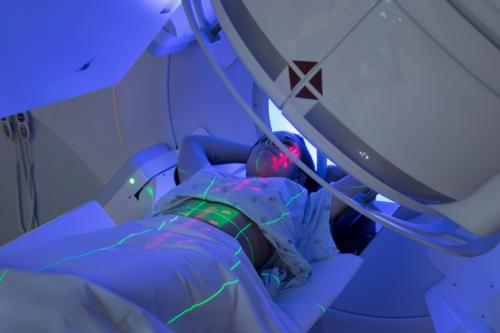
Most often, radiation therapy uses the external beam technique, which aims a beam of x-rays or protons directly at the tumor. Treatment is given in a series of sessions over six to seven weeks. For more detailed information, see the External Beam Therapy (EBT) page. Three-dimensional conformal radiation therapy or intensity-modulated radiation therapy (IMRT) use a 3-D image of the tumor taken with CT scanning. This image serves as the target for a high-dose radiation beam that can change in shape and size to match the tumor. This method minimizes radiation exposure of nearby normal lung tissue. See the Intensity-Modulated Radiation Therapy (IMRT) page for more information.
Proton therapy uses protons instead of x-rays. Protons can pass through healthy tissue without damaging it.
Doctors use systemic therapies to treat cancer that has already or is likely to spread throughout the body. Radiation therapy combined with chemotherapy and immunotherapy treats disease that has already spread to the lymph nodes. Occasionally, surgery may be done before chemotherapy and radiation therapy. Doctors typically treat late-stage disease that has already spread to other parts of the body with systemic treatments such as chemotherapy, targeted therapy, and/or immunotherapy. They may also use radiation therapy to consolidate any residual disease after systemic treatment and to relieve symptoms. Selection of the best treatment is frequently based on specific genetic tests done on tumor cells removed during a biopsy.
-
Chemotherapy uses drugs that kill cancer cells. Patients usually receive chemotherapy by direct injection into a vein or through a catheter placed in a large vein. Doctors often give chemotherapy after surgery to eliminate microscopic disease. Chemotherapy also may slow tumor growth and relieve symptoms in patients who cannot have surgery. Doctors are investigating newer biologic agents, which may have fewer side effects than chemotherapy and be just as effective. Chemotherapy treats all stages of lung cancer. It can prolong life even in elderly persons if they are in good general health. Some chemotherapy drugs increase the effectiveness of radiation treatment. Others keep the tumor cells at a stage where radiation treatment is more effective. Or they impair the cancer cells’ ability to repair themselves after radiation therapy. There is growing evidence that a combination of chemotherapy and radiotherapy is more effective than radiotherapy alone. However, there is a substantial risk of serious side effects.
Chemotherapy may cause significant side effects. These include nausea with vomiting and damage to the white blood cells that fight infection. However, there are ways to counter and treat most of these side effects.
Targeted therapy uses man-made molecules called monoclonal antibodies. Natural antibodies attack invading foreign substances, such as bacteria and viruses. Monoclonal antibodies act like natural antibodies by recognizing and binding to the surface of cancer cells. Your doctor may combine them with a chemotherapy drug or radioactive material. This allows the antibody to deliver the cancer-killing agent directly to the cancer cell.
Immunotherapy uses the body’s immune system to fight cancer. This type of therapy depends on the identification of markers on the surface of tumor cells.
How does the treatment method depend on the type of lung cancer?
There are two main types of lung cancer that have different microscopic appearances:
- Small-cell lung cancer (SCLC) is usually found in active or former cigarette smokers. Although SCLC is less common than non-small cell lung cancer (NSCLC), it is an aggressive tumor that is more likely to spread to other body sites. Chemotherapy is the primary treatment for SCLC. Your doctor may use radiation therapy with chemotherapy to treat lung tumors that have not spread beyond the chest or other organs. Because SCLC tends to spread quickly, surgery is not a common treatment. However, your doctor may use surgery to obtain tissue samples for lab analysis to determine the type of lung cancer present. SCLC patients may receive additional radiation therapy directed at the brain. This helps prevent cancer from spreading from the lungs to the brain.
- Non-small-cell lung cancer tends to grow slowly and takes longer to spread beyond the lung. Patients usually receive surgery and/or radiation therapy. Your treatment may also use chemotherapy to increase the effectiveness of surgery or radiotherapy. Chemotherapy in NSCLC is generally different than in SCLC. Also, different types of NSCLC may require different types of chemotherapy.
How does the stage of disease guide lung cancer treatment?
Small-cell lung cancer:
- Doctors use chemotherapy and radiation therapy to treat limited stage disease (confined to the chest). Radiation typically starts concurrently with the first or second dose of chemotherapy. Six weeks of once-daily radiation or three weeks of twice-daily radiation are common radiation regimens.
- The radiation oncologist may suggest radiation therapy directed at the brain for limited stage disease even though no cancer has been found there.
- Doctors usually use chemotherapy alone to treat extensive stage SCLC.
- The radiation oncologist may consider radiation therapy directed at the brain for extensive stage disease even though no cancer has been found there. There is less strong evidence for prophylactic brain radiation than in limited stage disease.
- The treatment team may also consider consolidation radiation to the bulky areas of the original tumor in the chest.
Radiotherapy or chemotherapy may help to reduce pain or other symptoms for disease recurrence or disease that persists after initial treatment. Radiotherapy or laser treatment can keep the airways open, allowing the patient to breathe more freely.
Non-small-cell lung cancer:
- Early Stage: The earliest NSCLCs are very small tumors. Special tests may be needed to locate the main tumor. Doctors treat early-stage tumors with surgery or stereotactic radiation therapy.
- Advanced Stage: Doctors use combined treatment when cancer has spread to structures near the lung, such as the chest wall, diaphragm , or lymph nodes in the chest. Depending on the exact location of cancer, patients may receive radiation therapy alone or combined with surgery and/or chemotherapy.
- Tumor that has spread to other parts of the body: Doctors use chemotherapy and targeted therapy for patients whose tumors have spread beyond the chest or into the opposite lung. Surgery does not generally benefit people whose cancer has spread beyond the chest. Chemotherapy prolongs life, and radiation therapy can help relieve symptoms caused by tumor. Sometimes, the doctor may recommend brain surgery for patients whose NSCLC has spread to the brain.
- Any lung cancer patient should consider taking part in a clinical trial to help find more effective treatments for lung cancer.
How effective is treatment for inoperable lung cancer?
It is extremely important to remember that “inoperable” does not mean “incurable” when it comes to lung cancer. In fact, an increasing number of patients are being treated with a non-surgical approach across all stages of this disease. Treatment effectiveness depends on the stage of disease. In early stage inoperable disease that is treated with radiotherapy alone, control of the local disease is typical. In more advanced disease, a combination of chemotherapy and radiation is delivered with curative intent. Cure rates are lower but still possible with disease spread to the lymph nodes within the chest. The medical or radiation oncologist may propose a combination of chemotherapy and radiation therapy for a patient who is otherwise well.
When cure is not a possibility, doctors recommend palliative treatment. This is the use of medications, chemotherapy, radiation therapy, or other measures to relieve symptoms of lung cancer without eliminating the tumor. The doctor will use smaller doses of radiation therapy to avoid side effects. At some point, if you and your oncologist or primary care physician agree that active treatment is no longer advisable, hospice care can provide comfort and support.
Pain relief is a very important part of treating lung cancer. Although many effective treatments are available, and there are devices for delivering medication on demand without overdosing, many cancer patients still do not receive adequate pain relief. When the needs of the patient are clearly expressed, doctors can better provide appropriate care.
What happens during radiation therapy?
Radiation therapy delivers focused high-energy x-rays (photons), gamma rays, or atomic particles. It affects cells that are rapidly dividing—such as cancer cells—much more than those that are not. Most cancers, including lung tumors, are made of cells that divide more rapidly than those in normal lung tissue. This means the tumor may be eliminated without damaging surrounding normal tissues. Radiotherapy acts by attacking the DNA within tumor cells, making it impossible for them to grow and create more cancer cells. Normal body cells may also be damaged, but they are able to repair themselves and function properly once again. The key is to give daily doses of radiation large enough to kill a high percentage of the rapidly dividing cancer cells, while minimizing damage to the more slowly dividing normal tissue cells in the same area.
What are possible side effects of radiation therapy?
- Overall, radiotherapy is a local treatment. Any side effects usually happen in the parts of the body where radiation passes through. Radiotherapy usually does not damage normal organs outside the path of the treatment beam.
- Most patients tire easily during their course of radiation treatment. This fatigue occurs two to three weeks after treatment starts and gradually increases as treatment continues. It may become severe and seriously limit your ability to engage in normal daily activities. Typically, fatigue lessens one to two months after radiotherapy is completed. If you experience fatigue, it is important to get enough rest. However, at the same time, your doctor may suggest that you stay as active as possible.
- Some patients experience hair loss on the chest included in the radiation field. Depending on how much radiation is delivered, this may be temporary or permanent.
- Skin irritation is common after a few weeks of radiation therapy. The affected area may be red, dry, tender, and itchy. This reaction can become quite severe during a long course of treatment. It helps to keep the skin clean with gentle soap and warm water, to dry it well, and to avoid very hot water while bathing. Sunscreen should be used when skin in the treated area is exposed to sunlight. Do not use perfumes, cosmetics, or deodorants in the treatment area. After daily treatments, you may apply an unscented cream or lotion.
- Temporary loss of appetite is a possibility.
- Esophagitis or inflammation of the esophagus (the tube that carries food from the mouth to the stomach) is common if radiotherapy is directed at the lymph nodes in the central chest or if the tumor is near the esophagus. This condition can be severe. The esophagus is very sensitive to radiation, and the symptoms are worse in patients who also receive chemotherapy. Esophagitis can make it difficult to swallow, and some patients need intravenous (IV) pain medication or fluids to get through the full course of radiation treatment. Some people experience esophagitis as the sensation of a lump or discomfort before it becomes overtly painful. Some foods (such as spicy or acidic foods or bread) feel worse than others. It is important to remember that although certain foods may cause pain with swallowing, they will not cause damage. Avoid foods that cause pain until about one month after the final day of radiation. The inflammation generally plateaus toward the end of treatment and starts to resolve within two to three weeks after treatment in most patients.
- An inflammation of the lungs called radiation pneumonitis may develop three to six months after radiotherapy is over. It causes coughing and shortness of breath as well as fever. In most cases, it calls for no specific treatment and gets better within two to four weeks. It can occasionally happen earlier and require steroids and/or oxygen.
- Decrease in a specific type of white blood cell called lymphocytes is another side effect of radiotherapy.
What kind of treatment follow-up should I expect?
Once radiotherapy ends, your doctor will want to see you after four to six weeks and then every three to six months for the first two years. After this, you may see the doctor every six months for three years and then once a year. Your medical or radiation oncologist will often prescribe a computed tomography (CT) or positron emission tomography (PET) scan. This will take place about four to eight weeks after treatment ends, when the response is expected to be the greatest. These images will help to assess response and make it possible to do comparisons with earlier images. It also allows your doctor to find treatment-related complications at an early stage. Imaging can tell the difference between recurrent cancer and lung scars produced by high-dose radiation treatment. By obtaining chest imaging on a regular basis, (generally no more than two to four times per year), recurrent cancers may be discovered in time to be successfully re-treated.
In addition to x-rays, other tests such as blood cell counts and bronchoscopy may be a routine part of the follow-up exam. Your doctor may use other tests to follow up on symptoms or findings on chest imaging. If new symptoms develop in another part of the body, your doctor may test to detect any potential problem.
After treatment, the tumor may be gone (cured). Or it can regrow in an area of the original tumor (recur) or remain after treatment (residual tumor). Patients who have had one cancer may develop a second, unrelated primary lung cancer. This happens to about 3 percent of patients per year.
Are there any new developments in treating my disease?
- Less invasive surgical methods are under study. They require a much smaller incision and allow the patient to be up within hours after surgery ends.
- Angiogenesis inhibitors are agents that prevent new blood vessels from forming in growing cancers and may shut off the tumor’s blood supply. This remains an experimental approach but it is promising in part because it seems to cause very few side effects.
Clinical Trials
For information and resources about clinical trials and to learn about current clinical trials being conducted, see:
- Clinical Trials - from RadiologyInfo's Screening section
- Clinical Trials - from the National Cancer Institute's Web site
Screening Trials
New Screening Recommendations
Additional Information and Resources
RTAnswers.org: Radiation Therapy for Lung Cancer
National Cancer Institute : Lung Cancer
American Cancer Society: Lung Cancer
Go2 Foundation: Lung Cancer Awareness
ACR : Lung Cancer Screening Resources
National Lung Cancer Roundtable: Lung Cancer Resources