Chest CT
Computed tomography (CT) of the chest uses special x-ray equipment to examine abnormalities found with other imaging tests and to help diagnose the cause of unexplained cough, shortness of breath, chest pain, fever, and other chest symptoms. CT scanning is fast, painless, noninvasive, and accurate. Because it can detect very small nodules in the lung, chest CT is especially effective for diagnosing lung cancer at its earliest, most curable stage.
Tell your doctor if there is a possibility you are pregnant and discuss any recent illnesses, medical conditions, medications you are taking, and allergies. You may be instructed not to eat or drink anything for a few hours beforehand. If you have a known allergy to contrast material, your doctor may prescribe medications to reduce the risk of an allergic reaction. These medications must be taken beginning 12-13 hours prior to your exam. Leave jewelry at home and wear loose, comfortable clothing. You may need to change into a gown for the exam.
- What is CT Scanning of the Chest?
- What are some common uses of the procedure?
- How should I prepare?
- What does the equipment look like?
- How does the procedure work?
- How is the procedure performed?
- What will I experience during and after the procedure?
- Who interprets the results and how do I get them?
- What are the benefits vs. risks?
- What are the limitations of CT Scanning of the Chest?
What is CT Scanning of the Chest?
Computed tomography, more commonly known as a CT or CAT scan, is a diagnostic medical imaging test. Like traditional x-rays, it produces multiple images or pictures of the inside of the body.
A CT scan generates images that can be reformatted in multiple planes. It can even generate three-dimensional images. Your doctor can review these images on a computer monitor, print them on film or via a 3D printer, or transfer them to a CD or DVD.
CT images of internal organs, bones, soft tissue, and blood vessels provide greater detail than traditional x-rays. This is especially true for soft tissues and blood vessels.
Doctors can use a variety of techniques to lower the amount of radiation needed to perform a chest CT scan. These techniques include adjusting the radiation dose based on patient size and new software technology. A low-dose chest CT produces images of enough quality to detect many lung diseases and abnormalities using much less radiation than a conventional chest CT scan. In some cases, doctors may lower the dose by 65 percent or more. Doctors routinely use low-dose chest CT to evaluate acquired and congenital lung abnormalities. These include pneumonia, interstitial lung disease, and tumors. There is ongoing research to lower radiation doses even further. Your radiologist will decide the proper settings for your scan depending on your medical issue and what information the CT scan needs to obtain. If your child is to have a CT scan, the doctor will use low-dose pediatric settings.
What are some common uses of the procedure?
Doctors use chest CT to:
- examine abnormalities found on chest x-rays.
- help diagnose the causes of signs or symptoms of chest disease, such as cough, shortness of breath, chest pain, or fever.
- detect and evaluate the extent of tumors that arise in the chest, or tumors that have spread there from other parts of the body.
- assess whether tumors are responding to treatment.
- help plan radiation therapy.
- evaluate injury to the chest, including the heart, blood vessels, lungs, ribs and spine.
Chest CT can demonstrate various lung disorders, such as:
- benign and malignant tumors
- pneumonia
- tuberculosis
- bronchiectasis, cystic fibrosis
- inflammation or other diseases of the pleura (the covering of the lungs)
- interstitial and chronic lung disease
- congenital abnormalities
The Centers for Medicare and Medicaid Services approves of CT scanning for lung cancer screening of smokers and ex-smokers who meet certain criteria. See the Lung Cancer Screening page for more information.
Your doctor may perform a CT angiogram (CTA) to evaluate the blood vessels (arteries and veins) in the chest. The technologist rapidly injects an iodine contrast material into a vein while obtaining CT images. See the CT Angiography (CTA) page for more information.
How should I prepare?
Wear comfortable, loose-fitting clothing to your exam. You may need to change into a gown for the procedure.
Metal objects, including jewelry, eyeglasses, dentures, and hairpins, may affect the CT images. Leave them at home or remove them prior to your exam. Some CT exams will require you to remove hearing aids and removable dental work. Women will need to remove bras containing metal underwire. You may need to remove any piercings, if possible.
Your doctor may instruct you to not eat or drink anything for a few hours before your exam if it will use contrast material. Tell your doctor about all medications you are taking and if you have any allergies. If you have a known allergy to contrast material, your doctor may prescribe medications (usually a steroid) to reduce the risk of an allergic reaction, or they may suggest another type of imaging when appropriate. To avoid unnecessary delays, contact your doctor well before the date of your exam.
Also tell your doctor about any recent illnesses or other medical conditions and whether you have a history of heart disease, asthma, diabetes, kidney disease, or thyroid problems. Any of these conditions may increase the risk of an adverse effect.
Women should always inform their physician and the CT technologist if there is any possibility that they may be pregnant. See the CT Safety During Pregnancy page for more information.
What does the equipment look like?
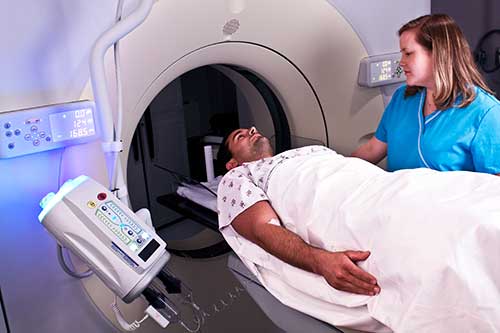
The CT scanner is typically a large, donut-shaped machine with a short tunnel in the center. You will lie on a narrow table that slides in and out of this short tunnel. Rotating around you, the x-ray tube and electronic x-ray detectors are located opposite each other in a ring, called a gantry. The computer workstation that processes the imaging information is in a separate control room. This is where the technologist operates the scanner and monitors your exam in direct visual contact. The technologist will be able to hear and talk to you using a speaker and microphone.
How does the procedure work?
In many ways, a CT scan works like other x-ray exams. Different body parts absorb x-rays in different amounts. This difference allows the doctor to distinguish body parts from one another on an x-ray or CT image.
A conventional x-ray exam directs a small amount of radiation through the body part under examination. A special electronic image recording plate captures the image. Bones appear white on the x-ray. Soft tissue, such as the heart or liver, shows up in shades of gray. Air appears black.
With CT scanning, several x-ray beams and electronic x-ray detectors rotate around you. These measure the amount of radiation being absorbed throughout your body. Sometimes, the exam table will move during the scan. A special computer program processes this large volume of data to create two-dimensional cross-sectional images of your body. The system displays the images on a computer monitor. CT imaging is sometimes compared to looking into a loaf of bread by cutting the loaf into thin slices. When the computer software reassembles the image slices, the result is a very detailed multidimensional view of the body's interior.
Nearly all CT scanners can obtain multiple slices in a single rotation. These multi-slice (multidetector) CT scanners obtain thinner slices in less time. This results in more detail.
Modern CT scanners can image large sections of the body in just a few seconds, and even faster in small children. Such speed is beneficial for all patients. Speed is especially beneficial for children, the elderly, and critically ill – anyone who finds it difficult to stay still, even for the brief time necessary to obtain images.
For children, the radiologist will adjust the CT scanner technique to their size and the area of interest to reduce the radiation dose.
Low-dose CT scanning uses a variety of techniques to produce high-quality scans at a lower radiation dose, including:
- adjusting the radiation dose to only what is needed to scan each part of the body
- using "noise management" software
- turning off or lowering the x-ray tube during part of its rotation
- lowering peak voltage settings
Your radiologist will select the appropriate dose reduction method(s) to accomplish the lowest possible dose necessary to answer the clinical question at hand.
How is the procedure performed?
The technologist begins by positioning you on the CT exam table, usually lying flat on your back. They may use straps and pillows to help you maintain the correct position and remain still during the exam.
Many scanners are fast enough to scan children without sedation. In special cases, children who cannot hold still may need sedation. Motion may cause blurring of the images and degrade image quality the same way that it affects photographs.
If your exam uses a contrast material, the nurse or technologist will inject it into a vein shortly before scanning begins.
Next, the table will move quickly through the scanner to determine the correct starting position for the scans. Then, the table will move slowly through the machine for the actual CT scan. Depending on the type of CT scan, the machine may make several passes.
The technologist may ask you to hold your breath during the scanning. Any motion, including breathing and body movements, can lead to artifacts on the images. This loss of image quality can resemble the blurring seen on a photograph taken of a moving object.
When the exam is complete, the technologist will ask you to wait until they verify that the images are of high enough quality for accurate interpretation by the radiologist.
The actual CT scanning takes less than 30 seconds. The entire process, including exam prep, usually takes about 30 minutes.
What will I experience during and after the procedure?
CT exams are generally painless, fast, and easy. Multidetector CT reduces the amount of time that the patient needs to lie still.
Though the scan is painless, you may have some discomfort from remaining still for several minutes or from placement of an IV. If you have a hard time staying still, are very nervous, anxious, or in pain, you may find a CT exam stressful. The technologist or nurse, under the direction of a doctor, may offer you some medication to help you tolerate the CT exam.
If the exam uses iodinated contrast material, your doctor will screen you for chronic or acute kidney disease. The doctor may administer contrast material intravenously (by vein), so you will feel a pin prick when the nurse inserts the needle into your vein. You may feel warm or flushed as the contrast is injected. You also may have a metallic taste in your mouth. This will pass. You may feel a need to urinate. However, these are only side effects of the contrast injection, and they subside quickly.
When you enter the CT scanner, you may see special light lines projected onto your body. These lines help ensure that you are in the correct position on the exam table. With modern CT scanners, you may hear slight buzzing, clicking and whirring sounds. These occur as the CT scanner's internal parts, not usually visible to you, revolve around you during the imaging process.
You will be alone in the exam room during the CT scan, unless there are special circumstances. For example, sometimes a parent wearing a lead shield may stay in the room with their child. However, the technologist will always be able to see, hear and speak with you through a built-in intercom system.
After a CT exam, the technologist will remove your intravenous line. They will cover the tiny hole made by the needle with a small dressing. You can return to your normal activities immediately.
Who interprets the results and how do I get them?
A radiologist, a doctor specially trained to supervise and interpret radiology exams, will analyze the images. The radiologist will send an official report to the doctor who ordered the exam.
You may need a follow-up exam. If so, your doctor will explain why. Sometimes a follow-up exam further evaluates a potential issue with more views or a special imaging technique. It may also see if there has been any change in an issue over time. Follow-up exams are often the best way to see if treatment is working or if a problem needs attention.
What are the benefits vs. risks?
Benefits
- CT is fast, which is important for patients who have trouble holding their breath.
- CT is widely available.
- CT scanning is painless, noninvasive, and accurate.
- A major advantage of CT is its ability to image bone, soft tissue, and blood vessels all at the same time.
- Unlike conventional x-rays, CT scanning provides very detailed images of many types of tissue as well as the lungs, bones, and blood vessels.
- CT exams are fast and simple. In emergency cases, they can reveal internal injuries and bleeding quickly enough to help save lives.
- CT has been shown to be a cost-effective imaging tool for a wide range of clinical problems.
- CT is less sensitive to patient movement than MRI.
- Unlike MRI, an implanted medical device of any kind will not prevent you from having a CT scan.
- CT imaging provides real-time imaging, making it a good tool for guiding needle biopsies and needle aspirations. This is particularly true of procedures involving the lungs, abdomen, pelvis, and bones.
- A diagnosis via CT scan may eliminate the need for exploratory surgery and surgical biopsy.
- No radiation remains in a patient's body after a CT exam.
- The x-rays used for CT scanning should have no immediate side effects.
- Low-dose CT scans of the chest use a lower dose of radiation than conventional chest CT.
Risks
- There is always a slight chance of cancer from excessive exposure to radiation. However, the benefit of an accurate diagnosis far outweighs the risk involved with CT scanning.
- The radiation dose for this procedure varies. See the Radiation Dose page for more information.
- Women should always tell their doctor and x-ray or CT technologist if there is any chance they are pregnant. See the Radiation Safety page for more information about pregnancy and x-rays.
- Doctors do not generally recommend CT scanning for pregnant women unless medically necessary because of potential risk to the unborn baby.
- The risk of serious allergic reaction to contrast materials that contain iodine is extremely rare. Radiology departments are well-equipped to deal with such reactions.
- In some patients with reduced kidney function, CT contrast material may worsen kidney function.
- There is a small chance of contrast leakage outside the vein at the site of an IV insertion site (“extravasation”). However, the technologist monitors for IV problems and the amount of leakage is usually small and easily treated.
- Because children are more sensitive to radiation, they should have a CT exam only if it is essential for making a diagnosis. They should not have repeated CT exams unless necessary. CT scans in children should always be done with low-dose technique.
What are the limitations of CT Scanning of the Chest?
A person who is very large may not fit into the opening of a conventional CT scanner. Or, they may be over the weight limit—usually 450 pounds—for the moving table.
Magnetic resonance imaging (MRI) may show some types of soft-tissue abnormalities better than CT.
Even though the CT exam is very fast, motion from breathing or body movement during the exam may result in blurring of the images.
Additional Information and Resources
RTAnswers.org: Radiation Therapy for Lung Cancer
This page was reviewed on September 30, 2024