Last reviewed on April 15, 2024
Radiation Therapy
Radiation therapy damages cancer cells' DNA to destroy their ability to divide and grow. Your doctor may use machines to deliver treatment. Or the doctor may place radioactive sources inside your body. Radiation oncologists use radiation therapy to cure cancer, relieve pain, and ease related symptoms.
Your doctor targets the radiation to the cancer as precisely as possible. This helps minimize side effects and avoid damage to normal cells. Sometimes, areas that are at risk for cancer spread are also included in the radiation field to prevent the cancer from coming back. Even with the most advanced treatment and imaging, some normal tissue will receive radiation. Your doctor will discuss any expected side effects during and after your radiation treatments.
Overview
An increasing number of cancer patients have success with radiation therapy. The use of three-dimensional imaging, computerized treatment planning and high-energy x-rays make precise treatment possible.
Radiation therapy professionals include:
- Radiation oncologists
- Radiation therapists
- Radiation oncology nurses
- Medical radiation physicists
- Dosimetrists
- Social workers
- Dietitians
Click on any of the professionals above to learn more about that specialty.
What is radiation therapy?
Radiation therapy uses high-energy x-rays to damage and destroy cancer cells. Your doctor may use it to cure your cancer, relieve your pain, or ease other cancer-related symptoms. Radiation therapy treats more than half of all cancer patients.
Radiation therapy damages cancer cells’ DNA to destroy their ability to divide and grow. The body then naturally rids itself of these damaged cells. Cancer cells are more vulnerable to radiation because:
- they divide more rapidly than normal cells
- they do not repair this damage as effectively as normal cells
How is radiation therapy used in cancer care?
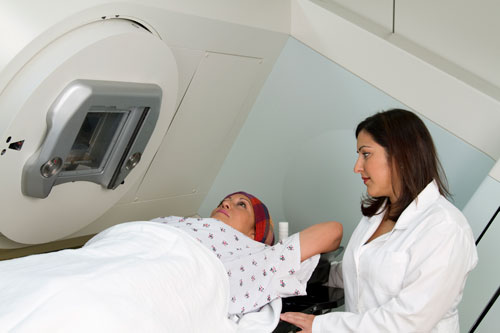
Your doctor may use external beam therapy (EBT) to treat you. EBT uses a linear accelerator to produce x-rays or gamma rays by accelerating electrons. Proton therapy is a form of EBT that uses cyclotrons or synchrotrons to produce charged atoms. Both methods can destroy tumors.
Your doctor may use brachytherapy to treat you. This treatment places radioactive sources inside your body on a temporary or permanent basis. The doctor seals the radioactive sources in needles, seeds, wires, or catheters and implants them directly into or near a tumor. Brachytherapy is a common treatment for cancers of the prostate, uterus, cervix and breast.
Radiation is the primary treatment for some patients. In other cases, radiation therapy and chemotherapy are delivered at the same time. This combined therapy can improve the effectiveness of treatment and reduce the chance that the cancer will return. Sometimes, the patient receives radiation therapy before (neoadjuvant treatment) or after (adjuvant treatment) surgery. Your doctor will work closely with other cancer specialists to determine the best path for your care.
Radiation Therapy Process
Planning will occur before your treatment begins. First, you will have a “simulation scan” on a special CT scanner. A simulation scan is a CT scan for radiation planning purposes. While you may have had a CT scan before, this scan is different and specific for radiation planning. The radiation therapy team will spend time placing you in a position that will be used during radiation treatment. This scan may use IV or oral contrast. If needed, the doctor will create a device (such as a mask) to help you keep still.
The radiation oncologist will outline the treatment area, tumor, areas at risk for cancer spread, and areas to avoid. Dosimetrists, medical physicists, and radiation oncologists will develop and check the radiation plan for quality and safety.
A radiation therapist will deliver your radiation therapy. The remaining healthcare team members will help manage any side effects.
Radiation Therapy Techniques
Radiation can also damage normal cells. Therefore, it is important to precisely target therapy to the cancer cells.
Intensity modulated radiation therapy (IMRT) precisely focuses radiation on the tumor from many different angles and intensities. This allows for safer delivery of higher doses of radiation.
Other ultra-precise techniques include stereotactic radiosurgery. This treatment uses 3-D imaging to find the tumor’s exact coordinates. Highly focused gamma rays or x-rays then converge on the tumor to treat it. The Gamma Knife® uses radioactive cobalt sources to focus multiple beams of radiation on the tumor. Linear accelerators can deliver stereotactic body radiation therapy (SBRT) to the brain and other parts of the body, including the prostate, lung, liver, and bone.
Your doctor may use image-guided radiation therapy (IGRT) with IMRT to precisely deliver radiation to the tumor. IGRT uses a CT scan or x-ray to align the target in the correct location for radiation therapy. Imaging is done before your treatment to make sure you are in the correct position and the tumor will be treated effectively.
In specialized cases such as cancer in the liver, your doctor may also use radiation delivered through your circulatory system. Radioembolization uses microspheres filled with radioactive isotopes to deliver high doses of radiation to the target through the blood supply.