Last reviewed on July 15, 2026
How to Prepare for Your CT Exam
This is a general description of how to prepare for most Computed Tomography (CT) exams. For information about a specific CT exam, see the CT – Tests and Treatments page.How should I prepare for my CT exam?
Wear comfortable, loose-fitting clothing to your exam. You may need to change into a gown for the procedure.
Metal objects, including jewelry, eyeglasses, dentures, and hairpins, may affect the CT images. Leave them at home or remove them prior to your exam. Some CT exams will require you to remove hearing aids and removable dental work. Women will need to remove bras containing metal underwire. You may need to remove any piercings, if possible.
Your doctor may instruct you to not eat or drink anything for a few hours before your exam if it will use contrast material. Tell your doctor about all medications you are taking and if you have any allergies. If you have a known allergy to contrast material, your doctor may prescribe medications (usually a steroid) to reduce the risk of an allergic reaction. To avoid unnecessary delays, contact your doctor well before the date of your exam.
Also tell your doctor about any recent illnesses or other medical conditions and whether you have a history of heart disease, asthma, diabetes, kidney disease, or thyroid problems. Any of these conditions may increase the risk of an adverse effect.
Women should always inform their physician and the CT technologist if there is any possibility that they may be pregnant. See the CT Safety During Pregnancy page for more information.
What does the CT equipment look like?
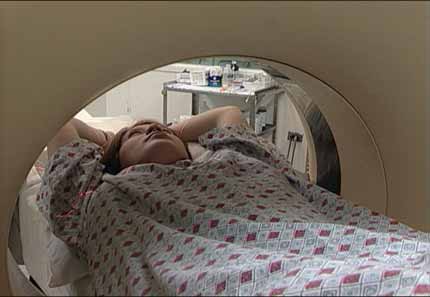
The CT scanner is a large, donut-shaped machine with a short tunnel in the center. You will lie on a narrow table that slides in and out of this short tunnel. Rotating around you, the x-ray tube and electronic x-ray detectors are located opposite each other in a ring, called a gantry. The computer workstation that processes the imaging information is in a separate room with a large window that allows the radiologic technologist to maintain visual contact as they operate the scanner and monitor your exam. The radiologic technologist will be able to hear and talk to you using a speaker and microphone.What will I experience during and after the procedure?
CT exams are generally painless, fast, and easy. Multidetector CT reduces the amount of time that the patient needs to lie still.
Though the scan is painless, you may have some discomfort from remaining still for several minutes or from placement of an IV. If you have a hard time staying still, are very nervous, anxious, or in pain, you may find a CT exam stressful. Before your CT exam appointment, talk to your doctor if you think you may need a medication to help you relax during the CT.
If the exam uses iodinated contrast material, your doctor will screen you for chronic or acute kidney disease. The doctor may prescribe contrast material to be given intravenously (by vein). You will feel a pin prick when the nurse inserts the needle into your vein.
If the exam uses iodinated contrast material, your doctor will screen you for chronic or acute kidney disease. The doctor may administer contrast material intravenously (by vein), so you will feel a pin prick when the nurse inserts the needle into your vein. You may feel warm or flushed as the contrast is injected. You also may have a metallic taste in your mouth. This will pass. You may feel a need to urinate. However, these are only side effects of the contrast injection, and they subside quickly.
If you swallow oral contrast material, you may find the taste mildly unpleasant. However, most patients can easily tolerate it. If you receive an enema, you can expect to experience a sense of abdominal fullness. You may also feel an increasing need to expel the liquid. If so, be patient; the mild discomfort will not last long.
When you enter the CT scanner, you may see special light lines projected onto your body. These lines help ensure that you are in the correct position on the exam table. With modern CT scanners, you may hear slight buzzing, clicking and whirring sounds. These occur as the CT scanner's internal parts, not usually visible to you, revolve around you during the imaging process.
You will be alone in the exam room during the CT scan, unless there are special circumstances. For example, sometimes a parent wearing a lead shield may stay in the room with their child. However, the technologist will always be able to see, hear and speak with you through a built-in intercom system.
With pediatric patients, a parent may be allowed in the room but may need to wear a lead apron to minimize radiation exposure.
After a CT exam, the technologist will remove your intravenous line. They will cover the tiny hole made by the needle with a small dressing. You can return to your normal activities immediately.
How does CT work?
In many ways, a CT scan works like other x-ray exams. Different body parts absorb x-rays in different amounts. This difference allows the doctor to distinguish body parts from one another on an x-ray or CT image.
A conventional x-ray exam directs a small amount of radiation through the body part under examination. A special electronic image recording plate captures the image. Bones appear white on the x-ray. Soft tissue, such as the heart or liver, shows up in shades of gray. Air appears black.
With CT scanning, several x-ray beams and electronic x-ray detectors rotate around you. These measure the amount of radiation being absorbed throughout your body. Sometimes, the exam table will move during the scan. A special computer program processes this large volume of data to create two-dimensional cross-sectional images of your body. The system displays the images on a computer monitor. CT imaging is sometimes compared to looking into a loaf of bread by cutting the loaf into thin slices. When the computer software reassembles the image slices, the result is a very detailed multidimensional view of the body's interior.
Nearly all CT scanners can obtain multiple slices in a single rotation. These multi-slice (multidetector) CT scanners obtain thinner slices in less time. This results in more detail.
Modern CT scanners can image large sections of the body in just a few seconds, and even faster in small children. Such speed is beneficial for all patients. Speed is especially beneficial for children, the elderly, and critically ill – anyone who finds it difficult to stay still, even for the brief time necessary to obtain images.
For children, the radiologic technologist will adjust the CT scanner technique to their size and the area of interest to reduce the radiation dose.
Some CT exams use a contrast material to enhance visibility in the body area under examination.
How is the procedure performed?
The technologist begins by positioning you on the CT exam table, usually lying flat on your back. They may use straps and pillows to help you maintain the correct position and remain still during the exam.
Many scanners are fast enough to scan children without sedation. In special cases, children who cannot hold still may need sedation. Motion may cause blurring of the images and degrade image quality the same way that it affects photographs.
The exam may require contrast material, depending on the type of exam. If so, it can be swallowed, injected through an intravenous line (IV) or, rarely, administered by enema. Depending on what exam your doctor ordered, you may be prescribed a combination of both oral and IV contrast material.
Next, the table will move quickly through the scanner to determine the correct starting position for the scans. Then, the table will move slowly through the machine for the actual CT scan. Depending on the type of CT scan, the machine may make several passes.
The technologist may ask you to hold your breath during the scanning. Any motion, including breathing and body movements, can lead to artifacts on the images. This loss of image quality can resemble the blurring seen on a photograph taken of a moving object.
When the exam is complete, the technologist will ask you to wait until they verify that the images are of high enough quality for accurate interpretation by the radiologist.
The CT examination is usually completed within 30 minutes. The portion requiring intravenous contrast injection usually lasts less than a minute.