Last reviewed on June 15, 2026
How to Prepare for Your MRI Exam
This is a general description of how to prepare for most Magnetic Resonance Imaging (MRI) exams. For information about a specific MRI exam, see the MRI – Tests and Treatments page.How should I prepare for my MRI exam?
Most MRI facilities will ask you to change into a hospital gown or hospital scrubs. Guidelines about eating and drinking before an MRI vary between specific exams and facilities. Take food and medications as usual unless your doctor tells you otherwise.
Some MRI exams use an intravenous (IV) injection of contrast material. The radiologic technologist will ask if you have allergies to contrast material. They also may ask you if you have known kidney disease or risk factors for kidney disease. You may need a blood test to assess your kidney function before having an MRI with contrast. MRI exams commonly use a contrast material called gadolinium. Gadolinium can be used safely in patients who are allergic to iodine contrast.
You should always tell your doctor and radiologic technologist if you are pregnant. MRI has been used since the 1980s with no reports of any ill effects on pregnant people or their unborn babies. However, the baby will be in a strong magnetic field. Therefore, pregnant people should not have an MRI in the first trimester unless the benefit of the exam clearly outweighs any potential risks. Pregnant people should not receive gadolinium contrast unless absolutely necessary. See the MRI Safety During Pregnancy page for more information about pregnancy and MRI.
If you have claustrophobia (fear of enclosed spaces) or anxiety, ask your doctor to prescribe a mild sedative prior to the date of your exam. Do not drive yourself home if you are taking sedative medication before undergoing your MRI. These medications can make it dangerous to drive, so make sure you have a ride home arranged.
Leave all jewelry and other accessories at home or remove them prior to the MRI scan. Patients should also be makeup free as some makeup contains metal. This can cause artifacts on the medical image due to metal interacting with the magnetic field. Metal and electronic items are not allowed in the exam room. They can interfere with the magnetic field of the MRI unit, cause burns, or become harmful projectiles. These items include:
- jewelry, watches, credit cards, and hearing aids, all of which can be damaged
- pins, hairpins, metal zippers, and similar metallic items, which can distort MRI images
- removable dental work
- pens, pocketknives, and eyeglasses
- body piercings
- mobile phones, electronic watches, and tracking devices.
In most cases, an MRI exam is safe for patients with metal implants, except for a few types. People with the following implants may not be scanned and should not enter the MRI scanning area without first being evaluated for safety:
- some cochlear (ear) implants
- some types of clips used for brain aneurysms
- some older cardiac defibrillators and pacemakers
- some spinal or nerve stimulators
Tell the radiologic technologist if you have medical or electronic devices in your body. These devices may interfere with the exam or pose a risk. Many implanted devices will have a pamphlet explaining the MRI risks for that device. If you have the pamphlet, bring it to the attention of the scheduler before the exam. MRI cannot be performed without confirmation and documentation of the type of implant and MRI compatibility. You should also bring any pamphlet to your exam in case the radiologist or radiologic technologist has any questions.
If there is any question, an x-ray may be taken to detect and identify any metal objects. Metal objects used in orthopedic surgery generally pose no risk during MRI.
Tell the radiologic technologist or radiologist about any shrapnel, bullets, or other metal that may be in your body. Foreign bodies near and especially lodged in the eyes are very important because they may move or heat up during the scan and cause injury to the eye. Dyes used in tattoos may contain iron and could heat up during an MRI scan. This is rare but let your radiologic technologist know if you feel heating during the exam.
Infants and young children often require sedation or anesthesia to complete an MRI exam without moving. This depends on the child's age, intellectual development, and the type of exam. Sedation is available at many facilities. A specialist in pediatric sedation or anesthesia should be available during the exam for your child's safety. You will receive instructions on how to prepare your child.
Some facilities may have personnel who work with children to help avoid the need for sedation or anesthesia. They may prepare children by showing them a model MRI scanner and playing the noises they might hear during the exam. They also answer any questions and explain the procedure to relieve anxiety. Some facilities also provide goggles or headsets so the child can watch a movie during the exam. This helps the child stay still and allows for good, quality images.
What does the MRI equipment look like?
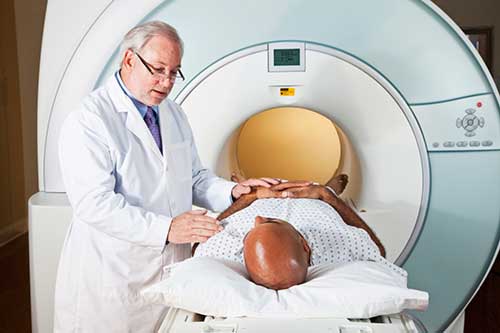
The traditional MRI unit is a large cylinder-shaped tube that looks like a big donut. You will lie on a table that slides into a tunnel towards the center of the MRI machine.
Some MRI units are designed to be more “open” which can help patients who have severe claustrophobia. Open MRI is not available for certain exams. For more information, consult your radiologist.
Some newer MRI machines have a larger diameter bore, which can be more comfortable for larger patients or those with claustrophobia.
How does MRI work?
Unlike x-ray and computed tomography (CT) exams, MRI does not use radiation. MRI uses a high-power magnet to temporarily change the position of hydrogen atoms that naturally exist within the body. This does not cause any long-term changes in your body. As the hydrogen atoms return to their usual position, they emit different amounts of energy depending on the type of tissue they are in. The scanner captures this energy, and a computer creates a picture using this information.
Most MRI units produce the magnetic field by passing an electric current through wire coils. Other coils are inside the machine and, in some cases, are placed around the part of the body being imaged. These coils send and receive radio waves, producing signals that the machine detects. The electric current does not come into contact with the patient.
MRI is often able to tell the difference between diseased tissue and normal tissue better than x-ray, CT, and ultrasound.
How is the procedure performed?
The radiologic technologist will position you on the movable exam table. They may use straps and bolsters to help you stay still and maintain your position.
The radiologic technologist may place devices that contain coils capable of sending and receiving radio waves around or next to the area of the body under examination. They may also place padding material around you to ensure your skin is not touching the inside of the machine or other parts of your body. Skin that touches skin on another part of your body or touches the machine can heat up during an MRI and cause a skin burn. Your radiologic technologist will explain this before your exam.
MRI exams create multiple types of pictures of the part of your body being imaged. When the machine is creating the pictures, you will hear loud clicking, tapping, and thumping noises. The radiologic technologist will give you earphones or ear plugs to wear to decrease the noise you hear during your exam.
If your exam uses a contrast material, a nurse or radiologic technologist will insert an intravenous catheter (IV line) into a vein in your hand or arm. They will use this IV to inject the contrast material.
The radiologic technologist will place you into the magnet of the MRI unit. They will perform the exam while working at a computer outside of the room. You will be able to talk to them via an intercom.
If your exam uses a contrast material, the radiologic technologist will inject it into the intravenous line (IV) after an initial series of scans. They will take more images during or following the injection. You may feel a little warm or have a strange taste in your mouth when you receive the contrast. This is normal and expected.
When the exam is complete, the radiologic technologist may ask you to wait while the radiologist checks the images in case more are necessary.
The radiologic technologist will remove your IV line after the exam is over and place a small dressing over the insertion site.
Depending on the type of exam and the equipment used, the entire exam usually takes 30 to 60 minutes.
What will I experience during and after the procedure?
Most MRI exams are painless. However, some patients find it uncomfortable to remain still. Others may feel closed-in (claustrophobic) while in the MRI scanner. The scanner can be noisy.
It is normal for the area of your body being imaged to feel slightly warm. If it bothers you, tell the radiologist or technologist. It is important that you remain perfectly still during the exam. You will know when the radiologic technologist is taking images because you will hear and feel loud tapping or thumping sounds. The coils that generate the radio waves make these sounds when they are activated. The radiologic technologist will provide you with earplugs or headphones to reduce the noise made by the scanner. You may be able to relax between imaging sequences. However, you will need to keep the same position as much as possible without moving.
You will usually be alone in the exam room. However, the radiologic technologist will be able to see, hear, and speak with you at all times using a two-way intercom. They will give you a “squeeze-ball” that alerts the radiologic technologist that you need attention right away. Many facilities allow a friend or parent to stay in the room once they are screened for safety.
The radiologic technologist will give children appropriately sized earplugs or headphones during the exam. Music may be played through the headphones to help pass the time. MRI scanners are air-conditioned and well-lit.
In some cases, you may receive an IV injection of contrast material before the radiologic technologist takes the images. The IV needle may cause you some discomfort and you may experience some bruising. There is also a tiny chance of skin irritation at the site of the IV tube insertion. Some patients may have a temporary metallic taste in their mouth after the contrast injection.
If you do not require sedation, no recovery period is necessary. You may resume your usual activities and normal diet immediately after the exam. On rare occasions, a few patients experience side effects from the contrast material. These may include nausea, headache, and pain at the site of injection. It is very rare that patients experience hives, itchy eyes, or other allergic reactions to the contrast material. If you have allergic symptoms, tell the radiologic technologist right away. A radiologist or other doctor will be available for immediate assistance.